
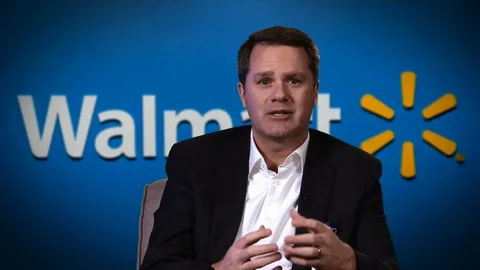
Two Names, One Search — and a Very American Story
Type “doug mcmillon and joaquin duato” into Google and you will notice something interesting. These two men have never worked together. They do not run rival companies. One sold groceries, toys and televisions. The other sells cancer medicines and surgical robots. They have probably shaken hands at some business dinner in New York or Davos, but there is no partnership, no feud and no joint venture between them.
So why do people search their names together? Because, side by side, they tell the same story from two completely different worlds. Both men joined a giant company in the 1980s in a junior job nobody envies. Both stayed for more than thirty years. Both were promoted again and again from the inside, in an age when most big companies hire celebrity CEOs from outside. And both ended up running not just any company, but one of the defining companies of American life — Walmart, where half of America shops, and Johnson & Johnson, whose products sit in almost every family medicine cabinet on earth.
There is one more reason the pairing is popular right now. Their stories are at different chapters. Doug McMillon stepped down as Walmart’s president and chief executive on 31 January 2026, closing a twelve-year run in the top job, and handed over to John Furner. Joaquin Duato, meanwhile, is in the middle of his run — chief executive of Johnson & Johnson since January 2022 and chairman since January 2023 — and is still reshaping that company after the biggest break-up in its history. One career is a completed story you can judge in full. The other is still being written. Comparing them is a neat way to ask a bigger question: what does it actually take to rise from the shop floor to the corner office, and stay there?
This article answers that question honestly. You will get both men’s backgrounds, their climb through the ranks, what each one actually changed at his company, how their leadership styles differ, and what they earn — with a clear warning wherever a number is an estimate rather than a fact from a company filing. No hype, no copied press releases. Just two careers, laid out plainly.
The Quick Answer: Who Are They?
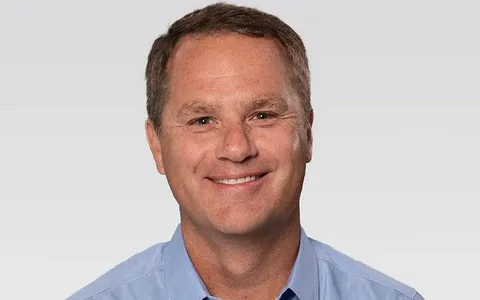
Doug McMillon in 30 seconds
Carl Douglas McMillon, known to everyone as Doug, is the former president and chief executive officer of Walmart Inc., the world’s largest retailer. He became CEO on 1 February 2014 and retired from the role on 31 January 2026. His story is the one Walmart loves to tell, because it is true: he first worked for the company in 1984 as a teenage summer associate unloading trailers at a distribution centre, earning an hourly wage, and he spent his entire working life there — more than four decades — before taking the top job. Under him, Walmart pushed hard into e-commerce, raised worker pay, invested in automation and artificial intelligence, and grew annual revenue from roughly $476 billion in the year he took over to about $681 billion in fiscal 2025 and $713 billion in fiscal 2026.
Joaquin Duato in 30 seconds
Joaquin Duato is the chairman and chief executive officer of Johnson & Johnson, the world’s most comprehensive healthcare company. He became CEO in January 2022 and added the chairman’s title in January 2023. He is only the eighth chief executive in the company’s long history since it became a public company. Duato is Spanish-American, a dual citizen of Spain and the United States, and he joined Johnson & Johnson in 1989 in its pharmaceutical business in Spain. He is credited with turning around the company’s struggling medicines division in the 2000s and 2010s, and as CEO he completed the 2023 separation of the consumer health business — Tylenol, Band-Aid, Listerine and Neutrogena — into a new independent company called Kenvue, leaving Johnson & Johnson focused on innovative medicines and medical technology.
Doug McMillon and Joaquin Duato at a Glance
| Doug McMillon | Joaquin Duato | |
| Full name | Carl Douglas McMillon | Joaquin Duato Boix |
| Born | 17 October 1966, Memphis, Tennessee, USA | April 1962, Valencia, Spain |
| Nationality | American | Spanish-American (dual citizen) |
| Company | Walmart Inc. | Johnson & Johnson |
| Top role | President and CEO | Chairman and CEO |
| In the top job | 1 Feb 2014 to 31 Jan 2026 | CEO since Jan 2022; Chairman since Jan 2023 |
| Joined the company | 1984, as an hourly summer associate | 1989, at Janssen in Spain |
| Education | Bachelor’s, University of Arkansas (1989); MBA, University of Tulsa (1991) | MBA, ESADE Business School, Barcelona; Master of International Management, Thunderbird School of Global Management |
| Rose through | Buying and merchandising, Sam’s Club, Walmart International | Pharmaceuticals, then group-wide strategy, supply chain and technology |
| Signature achievement | Turning Walmart into a people-led, tech-powered omnichannel retailer | Rebuilding J&J’s pharma business, then splitting off Kenvue in 2023 |
| Company scale (latest reported) | About $713 billion revenue (fiscal 2026); about 2.1 million associates | About $94.2 billion sales (2025); about 138,000 employees |
| Recent annual pay | About $27.4 million total compensation (2025 reporting) | $32.8 million total compensation (2025); $28.4 million in 2023 and $24.3 million in 2024 |
| Status today | Retired as CEO; stayed on as adviser into fiscal 2027 | Still in post; also joining PepsiCo’s board from 1 December 2026 |
Doug McMillon: From Unloading Trucks to the Top of Walmart
A boy from Arkansas, in a Walmart town
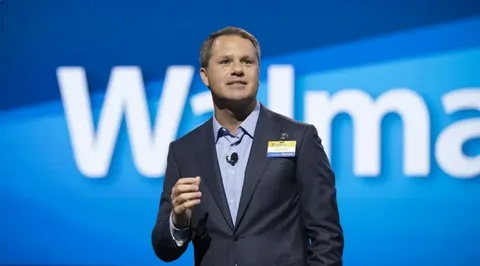
McMillon was born in Memphis, Tennessee, on 17 October 1966, and grew up mostly in Jonesboro, Arkansas, the oldest of three children. His father, Morris, was an accountant who had served in Vietnam, and his mother, Laura, kept the family grounded in ordinary small-town Arkansas life. Nothing in his childhood pointed to a corner office. He played sports, did well enough at school, and like thousands of Arkansas teenagers, he lived in a state where Walmart was not just a shop — it was the local economy.
The move that changed everything came when he was sixteen. The family relocated to Bentonville, a small town that happened to be Walmart’s hometown and headquarters. A year or so later, in 1984, McMillon took a summer job at a Walmart distribution centre, unloading trailers for an hourly wage — by his own telling, around $6.50 an hour. It was hot, physical, unglamorous work. Most summer associates never come back. He did, again and again, and that habit quietly became the foundation of one of the most complete insider careers in modern business.
He studied business administration at the University of Arkansas, graduating in 1989, and then earned an MBA in finance from the University of Tulsa in 1991. While studying for that MBA, he called Walmart and asked about coming back — this time not to a warehouse, but into the company’s buyer training programme. That phone call, as he has often joked, was the real start of his career.
The merchant years: fishing tackle, food and toys
McMillon joined full-time in 1991 as a buyer trainee, and his first buying responsibility was fishing tackle. It sounds like a joke in a CEO biography, but buying is the beating heart of Walmart. A buyer decides what millions of people will find on the shelf, at what price, and negotiates with the suppliers who make it. Get it right and you learn the whole business — customers, margins, logistics and human behaviour — in one job.
Running Sam’s Club, then the whole world
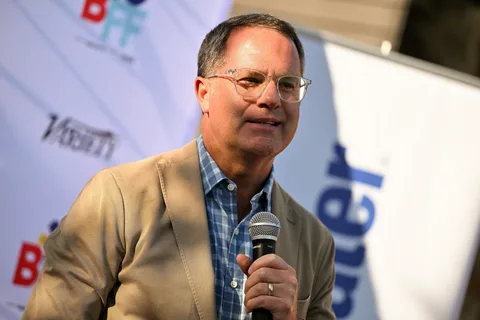
In August 2005, at just 38, McMillon was named president and CEO of Sam’s Club, a business then doing more than $46 billion a year in sales. The challenge was specific: Costco, the rival warehouse club, had built a devoted following with better-feeling stores and strong own-brand products. McMillon sharpened Sam’s Club’s focus on small-business customers, worked on the membership experience, and improved its competitive position in a category that was getting more crowded every year.
In February 2009 he was promoted again, to president and CEO of Walmart International. When he arrived, that division ran about 3,300 stores in 14 countries. When he left it in early 2014, it ran about 6,300 stores in 26 countries, with more than 700,000 associates, and international sales had grown to about 29 percent of the company’s total. Managing retail across Latin America, Europe, Asia, Africa and Canada — different laws, currencies, tastes and governments — was the final test. He passed it, and on 1 February 2014 he became Walmart’s fifth chief executive, succeeding Mike Duke.
What he actually changed as CEO
It is easy to list a CEO’s years. It is more useful to ask what is different because he was there. In McMillon’s case, four changes stand out, and all four are well documented.
First, e-commerce. When he took over, Walmart was still mainly a store company watching Amazon eat its future. McMillon spent heavily and sometimes painfully — buying Jet.com in 2016, taking a majority stake in India’s Flipkart in 2018, building grocery pickup and delivery into a mass habit, and turning thousands of stores into fulfilment points. The result is that Walmart is now routinely described, including by itself, as an omnichannel retailer rather than a discount chain.
Second, people. In 2015 Walmart raised its starting pay, and investment in wages, training, expanded parental leave and education followed in stages, including a programme that lets associates earn degrees and certificates without debt. Critics fairly note that retail wages remain modest and the debate about them never ended. But inside the company’s own history, the McMillon years were a clear turn toward spending real money on the workforce — partly from conviction, partly because tight labour markets left no choice.
Third, technology and the supply chain. Automation in distribution centres, artificial intelligence in forecasting and replenishment, a fast-growing advertising business and a marketplace for third-party sellers all scaled up on his watch. Walmart even moved its stock listing to the technology-focused Nasdaq in late 2025 — a symbolic moment, but symbols tell you how a company now sees itself.
Fourth, resilience. He led the company through the COVID-19 pandemic, when Walmart stores stayed open as essential retail while much of the economy shut, and then through the inflation shock that followed. Revenue kept climbing through all of it, passing $600 billion and then $700 billion. On his watch the company also hit major climate milestones, including its Project Gigaton supplier-emissions goal, reached years ahead of schedule according to the company.
The exit: planned, calm, and very Walmart
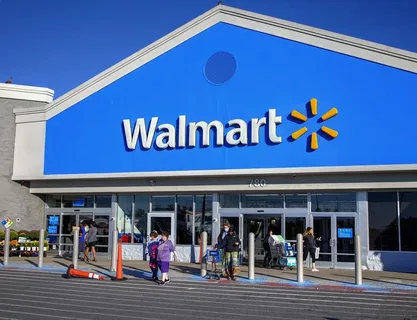
On 14 November 2025 Walmart announced that McMillon would retire as president and CEO effective 31 January 2026. There was no scandal, no activist investor, no sudden boardroom fight. He stayed on the board until the next shareholders’ meeting and agreed to remain an adviser through fiscal 2027 — the kind of orderly handover that investors like and journalists find slightly dull, which is exactly the point.
His successor, John Furner, is almost a copy of the same template: joined in 1993 as an hourly associate, ran Sam’s Club, then ran Walmart U.S. — the company’s largest division, with more than 4,600 stores — from 2019. McMillon said he had worked with Furner for more than twenty years and called him uniquely capable of leading Walmart through its next, AI-driven transformation. Walmart’s chairman, Greg Penner, credited McMillon with a comprehensive transformation — investing in associates, advancing digital and e-commerce, and modernising the supply chain. When a chairman can say that at a retirement announcement without anyone laughing, the handover has gone the way it was drawn up.
Joaquin Duato: The Pharmacist’s Grandson Running Johnson & Johnson
Healthcare was the family business before it was a career
Joaquin Duato was born in April 1962 and grew up in Valencia, on Spain’s Mediterranean coast. If McMillon’s childhood was shaped by a town, Duato’s was shaped by a profession. His mother worked in nursing care, his grandfather was a paediatrician, and his grandmother was a pharmacist. As he has put it himself, he found his passion for healthcare at home, long before he found Johnson & Johnson — and he found Johnson & Johnson in Spain, where he grew up.
1989: a start in Spain that nobody photographed
Duato joined Johnson & Johnson in 1989, working for Janssen, the company’s pharmaceutical arm, in Spain. There was no fast track and no drama. For more than a decade he held a series of roles across the business in Europe, learning how medicines are developed, approved, priced and sold in health systems that work nothing like the American one. That European grounding is still visible in how he talks about healthcare today — as a system, not just a market.
He moved to the United States in 2002, and from there his rise steepened. Senior roles across the pharmaceuticals business followed, and in 2011 he became Executive Vice President and Worldwide Chairman of Pharmaceuticals — in plain terms, the boss of J&J’s entire medicines division, the job that defined his reputation.
The pharma turnaround he is still known for
To understand why Duato got the top job, you have to understand what J&J’s pharmaceutical business looked like when he took charge of it. At the end of the 2000s the division was struggling: important patents were expiring, the pipeline looked thin, and many analysts considered medicines the weak leg of the famous three-legged company. Duato refocused the division around a smaller number of therapeutic areas where the medical need was greatest and where J&J could genuinely lead, invested accordingly, and rebuilt it over the 2011 to 2018 period into one of the company’s strongest performers — eventually one of the largest and fastest-growing pharmaceutical businesses in the world.
In 2018 he was promoted to Vice Chairman of the Executive Committee, a deliberately broad job: strategic oversight of both pharmaceuticals and consumer health, plus responsibility for the global supply chain and information technology — he even served for a period as interim chief information officer. When COVID-19 hit, he led much of the company’s operating response, keeping factories running and medicines moving to patients while supply chains everywhere else were seizing up. Like McMillon’s International years at Walmart, this was the final audition: the board watched him run the whole machine under maximum stress, and then gave him the machine.
CEO in 2022, chairman in 2023 — and one enormous decision
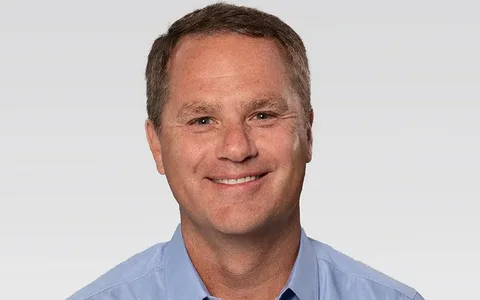
Duato became chief executive in January 2022, only the eighth CEO since Johnson & Johnson became a public company in 1944, and chairman in January 2023. He inherited a company facing hard questions: heavy litigation exposure, a shifting pharmaceutical landscape, and a long-running debate about whether the famous consumer brands — the Band-Aids and baby products everyone grew up with — still belonged inside the same company as cancer drugs and surgical devices.
His answer was the defining act of his tenure so far. In 2023 Johnson & Johnson separated its consumer health business into a new independent company, Kenvue, through an initial public offering in May and a split-off completed that August. Tylenol, Band-Aid, Listerine, Neutrogena and other household names went with Kenvue. What remained at Johnson & Johnson was a focused, two-pillar company: Innovative Medicine and MedTech. Duato described the result as a company able to innovate across the full spectrum of healthcare — medicines on one side; surgery, orthopaedics, cardiovascular intervention and vision care on the other — and acquisitions such as Abiomed and Shockwave Medical expanded the MedTech side into higher-growth procedures.
Since the split, his agenda has been consistent rather than flashy: concentrate research on six high-growth areas of unmet medical need — oncology, immunology, neuroscience, cardiovascular, surgery and vision; use artificial intelligence and data science as, in his words, a force multiplier in research and across the workforce; manage the loss of exclusivity on major drugs such as Stelara by growing newer medicines; and invest heavily in the United States, including a commitment announced at $55 billion over four years for American research, development and manufacturing. The company reported worldwide sales of $94.2 billion for 2025, up about 6 percent. He has also taken his experience outside J&J: PepsiCo announced in September 2026 that Duato will join its board as an independent director, serving on its audit committee, effective 1 December 2026. Honours along the way include Spain’s Order of Civil Merit, conferred by King Felipe VI in 2023.
Where They Are Alike — and Where They Could Not Be More Different
The similarities are real, not a headline trick
Both men are lifers. McMillon gave Walmart more than forty years; Duato has given Johnson & Johnson more than thirty-five. In modern corporate life that is almost an extinct career pattern. Boards today usually shop for a CEO the way football clubs shop for a striker. Walmart and J&J both grew theirs in the garden.
Both men also did their proving in the unglamorous middle of the business. McMillon’s credibility came from buying, stores and running big operating divisions on three continents. Duato’s came from rebuilding a division and then running supply chain and technology in a crisis. Neither man was a finance-department appointment, and neither was a marketing star. They were operators first, which is why both boards trusted them with transformation: they already knew where the bodies were buried, because they had helped build the place.
The differences explain their companies
Start with scale. Walmart’s revenue, at roughly $713 billion in fiscal 2026, is more than seven times Johnson & Johnson’s roughly $94 billion, and its roughly 2.1 million associates outnumber J&J’s roughly 138,000 employees many times over. But J&J earns far more profit from every dollar of sales, because a patented cancer medicine is not a gallon of milk. McMillon managed a business of almost unimaginable volume and razor-thin margins, where a decision about one cent on a price mattered. Duato manages a business where a single molecule, protected by patents and proven in decade-long clinical trials, can be worth billions — and where a single safety failure can destroy trust built over a century.
Leadership style, in one line each
If you had to compress each man into a sentence, most fair observers would land somewhere like this. McMillon: a merchant who led by walking the floor — people first, customers second, technology as the tool that serves both. Duato: a strategist who led by focusing the portfolio — patients first, science second, structure as the tool that serves both. Both styles sound simple. Both took thirty years to earn the right to use them.
Salary and Net Worth: The Honest Version
This is the section most readers came for, and it is also the section where the internet lies to you the most. So here is the honest method first: a CEO’s annual pay is a matter of public record, because listed companies must report it in proxy filings. A CEO’s net worth is not public record at all — every figure you will ever see is an outside estimate built from share-ownership disclosures, and different trackers produce different numbers. Treat pay as fact and net worth as a range.
What they were paid
McMillon’s total compensation was reported at about $27.4 million for the 2025 reporting cycle — roughly $1.5 million of that was base salary, with the large majority in stock awards and incentives that only pay out fully if the company performs. That structure is normal for a CEO at this level: the cash salary is almost a rounding error next to the equity.
Duato’s reported pay has moved around more. He received $28.4 million in 2023 — which made him the highest-paid CEO among major pharmaceutical companies that year — then $24.3 million in 2024, and about $32.8 million for 2025, including a $1.6 million base salary, around $21 million in stock and option awards, roughly $4.3 million in incentive pay, and a large change in pension value. Year-to-year jumps like that usually reflect how stock awards and pension calculations are valued in a given year, not a sudden change in the man’s salary. The two men’s annual pay, in other words, sits in the same broad neighbourhood — the mid-twenties to low-thirties of millions — which is simply the going rate for running a company of this size in the United States.
What they are worth — estimates, labelled as estimates
For McMillon, third-party trackers put his net worth broadly in the $300 million to $540 million range as he retired, driven mainly by his large Walmart shareholding — reported at various points as well over a million shares — and by years of stock awards. He is wealthy by any normal standard, but pointedly not a billionaire, and not a Walton: the founding family’s fortune belongs to the family, not to the hired — even lifelong — help.
For Duato, public estimates are thinner. Trackers reported his directly held Johnson & Johnson shares at roughly $84 million in 2024, which is a floor for his wealth rather than a full net worth figure, because it excludes pensions, deferred pay and assets nobody can see. Any website giving you a single precise Duato net worth to the nearest million is guessing with confidence it has not earned. The fair summary: both men end this story rich, neither ends it owning the company, and in both cases the fortune is mostly paper — shares in the one company each spent his life building.
Five Lessons Both Careers Teach
- 1. Loyalty still compounds. In a job-hopping era, both men traded mobility for mastery — and the final promotion went to the person who knew the company best.
- 2. Run the hard division before asking for the top job. Sam’s Club and International made McMillon; the pharma rebuild and the pandemic supply chain made Duato. Boards promote proven operators, not presenters.
- 3. Transformation looks different in every industry. Walmart needed more — channels, services, technology. J&J needed less — two pillars instead of three. The skill is diagnosing which one your company needs.
- 4. Quiet can beat loud. Neither man chased headlines, and both outlasted flashier contemporaries. Boards and employees tend to trust the calm person in a crisis.
- 5. Plan the exit while you are winning. McMillon’s calm, announced-in-advance handover to another insider is the model Duato’s board will presumably want when his chapter closes — whenever that is.
A Fair Word of Caution
Two honest limits on everything above. First, both men’s private lives are genuinely private. McMillon lives in Bentonville with his wife, Shelley, and they have two sons; Duato also has two children and keeps his family out of the spotlight. Details beyond that, circulating on celebrity-style websites, are largely unverified filler, and this article has left them out on purpose. Second, company numbers move: revenues, employee counts and pay packages are stated here as latest reported at the time of writing, and the pay figures especially should be re-checked against the newest proxy statements if you are publishing or citing them. Facts age; the shape of these two careers will not.
Frequently Asked Questions
Who is Doug McMillon?
Doug McMillon is the former president and chief executive officer of Walmart. He led the world’s largest retailer from 1 February 2014 until his retirement on 31 January 2026, after joining the company in 1984 as an hourly summer associate unloading trailers.
Who is Joaquin Duato?
Joaquin Duato is the chairman and chief executive officer of Johnson & Johnson. A Spanish-American executive who joined the company in Spain in 1989, he became CEO in January 2022 and chairman in January 2023.
What is the connection between Doug McMillon and Joaquin Duato?
There is no business partnership between them. They are compared because their careers rhyme: both joined giant American companies in junior roles in the 1980s, stayed for more than three decades, and rose internally to the very top — one in retail, one in healthcare.
Who replaced Doug McMillon at Walmart?
John Furner, the former president and CEO of Walmart U.S., took over as Walmart’s president and CEO on 1 February 2026. Like McMillon, Furner started as an hourly associate, joining in 1993.
What is Doug McMillon’s net worth?
It is an estimate, not a published figure. Third-party trackers placed it broadly between $300 million and $540 million around his retirement, based mainly on his Walmart shareholding and years of stock awards. He is not a billionaire.
What is Joaquin Duato’s net worth?
No verified total exists. Trackers reported his directly held Johnson & Johnson shares at roughly $84 million in 2024, but that excludes pensions, deferred compensation and private assets, so his true net worth is higher and not precisely knowable from public data.
How much did Doug McMillon earn as Walmart CEO?
His total compensation was reported at about $27.4 million for the 2025 reporting cycle, including a base salary of about $1.5 million, with most of the package in stock awards and performance incentives.
How much does Joaquin Duato earn at Johnson & Johnson?
His reported total compensation was $28.4 million in 2023, $24.3 million in 2024 and about $32.8 million for 2025. His base salary is about $1.6 million; the rest is stock, options, incentives and pension-value changes.
What is Joaquin Duato’s biggest achievement at Johnson & Johnson?
Two stand out: rebuilding the pharmaceuticals division into a top global performer during his 2011–2018 tenure as its worldwide chairman, and, as CEO, completing the 2023 separation of the consumer health business into Kenvue, refocusing J&J on innovative medicine and MedTech.
What is Doug McMillon’s biggest achievement at Walmart?
Transforming a store-based discount chain into an omnichannel, technology-powered retailer — scaling e-commerce, grocery pickup and delivery, automation and advertising — while raising investment in worker pay and education and growing revenue past $700 billion.
Final Verdict
Doug McMillon and Joaquin Duato will never run the same company, work in the same industry or, in all likelihood, be photographed together. But as a pair, they make one useful point better than almost any two executives alive. The modern business world insists that the top job goes to whoever moves fastest between companies. These two men are the counter-argument. One unloaded trucks in the town he grew up next to; the other sold medicines in the country he was born in. Both simply stayed, learned every floor of the building, fixed the hardest room in it — and were eventually handed the keys to the whole place.
McMillon’s story is now complete, and it ends the way he would have wanted: a quiet announcement, a hand-picked insider successor, and a company bigger, more digital and more valuable than the one he inherited. Duato’s story is at its midpoint, with the Kenvue split behind him and the harder test — proving the smaller, sharper Johnson & Johnson grows faster than the old one — still ahead. Check back in a few years. If the pattern of his whole career holds, the patient insider from Valencia will still be there, still calm, and still playing the long game.
Sources consulted for this article include Walmart and Johnson & Johnson company announcements and leadership biographies, company proxy and results reporting, and coverage by Reuters-syndicated and specialist business publications. Pay and net worth figures are labelled in the text wherever they are third-party estimates.







Leave a Reply