
Introduction
The world is full of processes that influence how people communicate, learn, adapt, and interact with their surroundings. Some changes happen gradually, while others take place because of environmental conditions, social relationships, or personal experiences. One concept that helps explain several of these processes is assimilasjon.
Assimilasjon is a Norwegian word commonly translated into English as assimilation. It describes a process in which something becomes similar to, adapts to, or incorporates elements of something else. Although the word may initially sound like a complicated academic term, it has applications in several areas of everyday life.
People encounter assimilation in language, sociology, psychology, biology, education, and other scientific fields. Its meaning changes depending on the subject being discussed. In sociology, it can describe how individuals or cultural groups adapt to a dominant society. In linguistics, it explains how one speech sound influences another. In psychology, it can describe how people understand new experiences through knowledge they already possess.
The concept is especially interesting because it connects different types of change. It helps explain why languages develop, how individuals learn, how societies change, and how living organisms process essential substances.
Understanding assimilasjon requires looking beyond a single definition. This guide explores its meaning, different forms, practical examples, historical background, benefits, limitations, and importance in modern society.
What Does Assimilasjon Mean?
Assimilasjon is a Norwegian noun that refers to assimilation. Its general meaning involves becoming similar to something else or adapting something new to an existing structure.
According to Norwegian dictionary definitions, assimilasjon can describe adaptation or transformation into something already existing. It is also used as a technical term in fields such as linguistics, geology, physiology, psychology, and botany.
The word comes from the Latin assimilare, meaning to make similar.
Although the basic idea remains connected to similarity and adaptation, its practical meaning depends on context.
For example, when discussing immigration, assimilation may refer to the process through which people adopt aspects of the culture and language of a majority population.
When discussing language, it describes a sound becoming more similar to another sound.
In psychology, assimilation can involve interpreting new experiences through existing knowledge and mental structures.
These examples demonstrate that assimilasjon is not limited to one particular subject.
The Origin and Background of Assimilasjon
The history of the word provides useful insight into its meaning.
Assimilasjon has roots in Latin terminology associated with making something similar. Over time, the concept became established in several academic disciplines.
Its development reflects the fact that different subjects sometimes use the same general idea to explain completely different processes.
In language studies, assimilation became an important concept for understanding pronunciation and historical sound changes.
In sociology, researchers used assimilation to examine relationships between cultural groups and the ways minority populations adapted to majority societies.
In psychology, the term became important in theories explaining how people organize information and understand their surroundings.
In biology, related terminology describes how organisms incorporate and transform substances into materials needed for growth and functioning.
Today, assimilasjon remains relevant because it helps researchers explain adaptation, transformation, and relationships between existing and new elements.
Different Types of Assimilasjon
One of the most important things to understand about assimilasjon is that it has several meanings.
The following sections explain its main applications.
1. Cultural Assimilasjon
Cultural assimilation is one of the most widely discussed forms of assimilation.
It describes a process in which individuals or groups gradually adopt characteristics associated with another culture, often the culture of a larger or dominant population.
These characteristics may include language, customs, social expectations, clothing, communication styles, and everyday traditions.
For example, imagine someone moving from one country to another.
After living in the new country for several years, the person may learn the local language, understand social customs, and participate in community activities.
These changes can make everyday communication and social participation easier.
However, cultural assimilation can involve more than simply learning new customs.
In its stricter sociological meaning, assimilation can involve pressure on minority groups to abandon parts of their original cultural identity in order to resemble the majority population.
This distinction is important because voluntary cultural exchange is not necessarily the same as forced assimilation.
Examples of Cultural Assimilation
Consider a family that moves to a country where the majority population speaks a different language.
Their children may learn the local language at school and become comfortable communicating with classmates.
Over time, the family may also become familiar with local holidays, food preferences, and social traditions.
Some individuals may adopt many elements of the new culture while continuing to maintain their original traditions.
Others may gradually stop practicing certain cultural customs.
The experience differs between individuals and families.
Cultural Identity and Assimilation
Cultural identity includes the traditions, values, language, history, and experiences that help individuals understand their background.
Assimilation can influence these elements.
For some people, adopting a new culture creates opportunities for communication and participation.
For others, pressure to abandon their original identity can produce emotional difficulties.
A person should not have to lose their cultural background simply to participate in a wider community.
This is one reason why modern discussions often distinguish assimilation from integration.
2. Linguistic Assimilasjon
Linguistic assimilation is another important meaning of the term.
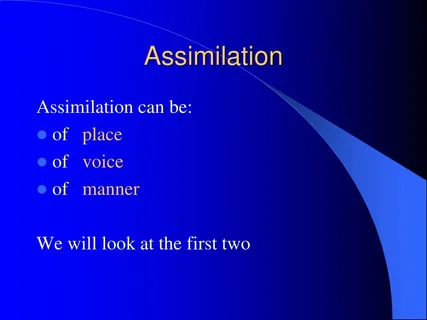
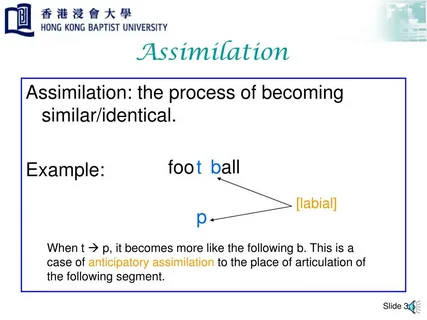
In linguistics, assimilation occurs when one speech sound becomes more similar to another sound.
This happens naturally during speaking because the human speech organs move continuously.
The tongue, lips, teeth, and other parts of the vocal system adjust their positions while producing sounds.
As a result, neighboring sounds can influence one another.
This process can make pronunciation easier and more natural.
Linguistic assimilation occurs in many languages, including Norwegian and English.
Contact Assimilation
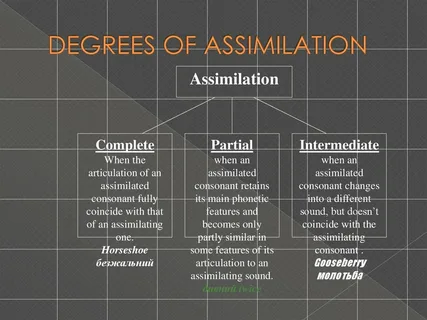
Contact assimilation occurs when two sounds influence each other while appearing close together in speech.
The sounds may become completely identical or share only certain characteristics.
This process is common in natural spoken language.
Speakers do not always pronounce every sound separately and independently. Instead, speech movements overlap.
This overlapping movement helps explain why pronunciation sometimes differs from the written form of a word.
Distant Assimilation
Distant assimilation occurs when one sound influences another sound even though they are not directly next to each other.
An example can be found in vowel harmony.
In languages such as Turkish, the vowel in one part of a word can influence the vowel used in a later grammatical ending.
The result is a pattern in which vowels become more similar according to particular language rules.
Distant assimilation also appears in historical language development.
Progressive Assimilation
Progressive assimilation occurs when an earlier sound influences a following sound.
The influence moves forward through the sequence of speech.
This can affect pronunciation and grammatical forms.
Regressive Assimilation
Regressive assimilation happens when a later sound influences an earlier sound.
The influence moves backward.
Historical examples in Scandinavian languages demonstrate how pronunciation changes can eventually become part of ordinary spelling.
Why Linguistic Assimilation Matters
Linguistic assimilation helps explain why spoken languages are not always pronounced exactly as they are written.
It is important for:
- Understanding pronunciation.
- Studying phonetics and phonology.
- Explaining historical sound changes.
- Learning foreign languages.
- Understanding natural speech patterns.
- Analyzing differences between dialects.
People learning a new language can benefit from understanding assimilation because it explains why certain sounds change when spoken together.
3. Social Assimilasjon
Social assimilation describes the process through which individuals or groups become increasingly similar to the wider society in which they live.
It may involve social relationships, participation in institutions, shared expectations, communication, and cultural practices.
For example, a person who moves to a new city may gradually become familiar with its community activities, workplace culture, and social expectations.
They may develop friendships with people from different backgrounds and become more involved in local organizations.
These experiences can influence how the person participates in society.
However, social assimilation can also involve unequal expectations.
If minority individuals are expected to change everything about their identity while the majority population makes no effort to understand them, the process becomes one-sided.
A healthy society should allow people to participate without treating cultural differences as a problem.
Social Assimilation in Everyday Life
Social assimilation can appear in ordinary situations.
A new employee learns how colleagues communicate and how workplace responsibilities are organized.
A student entering a new school becomes familiar with classroom expectations.
A family settling into a different community learns how local services operate.
These examples illustrate how individuals adjust to unfamiliar social environments.
However, learning how a community works does not necessarily require abandoning personal beliefs or cultural traditions.
4. Psychological Assimilasjon
Psychological assimilation is associated with the way people understand new information.
One important explanation comes from the work of Swiss psychologist Jean Piaget.
Piaget used assimilation as a concept in his theory of cognitive development.
In this context, assimilation occurs when people interpret new experiences through mental structures they have already developed.
For example, a young child who understands what a dog looks like may initially identify several different four-legged animals as dogs.
The child uses existing knowledge to interpret unfamiliar information.
Later, the child may learn that cats, horses, and dogs are different animals.
This shows how existing knowledge influences the way people initially understand new experiences.
Assimilation and Learning
Imagine a student who already understands basic mathematics.
When introduced to a new mathematical concept, the student may connect it with previously learned rules.
The existing knowledge provides a starting point for understanding the new information.
This process can make learning easier because people rarely approach every subject without prior experience.
They use memories, expectations, and previous knowledge to interpret what they encounter.
The Relationship Between Assimilation and Accommodation
Assimilation is closely connected to another psychological concept called accommodation.
Although the two processes are related, they are not identical.
Assimilation involves interpreting new information through existing mental structures.
Accommodation occurs when those structures are modified because the new information does not fit what a person already understands.
For example, a child may initially believe that all flying animals are birds.
After learning about bats, the child must adjust that understanding.
The new knowledge changes the existing mental category.
Both processes contribute to cognitive development.
5. Biological Assimilasjon
In biology, assimilation refers to processes through which organisms incorporate substances and use them to build or maintain their bodies.
Living organisms need nutrients and other materials to function.
Food is broken down into smaller components during digestion, and these substances can then be absorbed and used by the body.
Assimilation involves incorporating suitable substances into cells and tissues.
This process supports growth, repair, and normal biological activity.
Assimilation in Human Nutrition
When people eat food, the digestive system breaks it down into smaller substances.
These substances may include:
- Amino acids.
- Simple sugars.
- Fatty acids.
- Vitamins.
- Minerals.
- Other useful nutrients.
After absorption, the body uses these materials in different metabolic processes.
For example, amino acids can contribute to protein production, while glucose can provide energy for cellular activities.
The body does not simply store everything that enters the digestive system.
Nutrients are processed and used according to physiological needs.
Why Biological Assimilation Matters
Biological assimilation is important because organisms depend on materials from their surroundings.
Without the ability to incorporate essential nutrients, normal growth and tissue maintenance would not be possible.
It also illustrates how the same general concept can apply to a completely different scientific field.
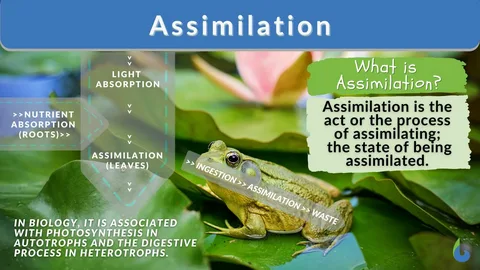
6. Assimilation in Plants
Plants use assimilation to incorporate inorganic substances into organic materials.
One important example is carbon assimilation during photosynthesis.
During photosynthesis, plants use light energy to help convert carbon dioxide and water into carbohydrates.
These substances provide materials that support plant growth and other biological processes.
Chlorophyll plays an important role in capturing light energy.
The process is essential to plant life and has a wider impact on ecosystems because plants form the foundation of many food chains.
The Importance of Carbon Assimilation
Carbon assimilation connects plant biology with the global carbon cycle.
Plants take carbon dioxide from the atmosphere and incorporate carbon into organic compounds.
These compounds become part of plant tissues and can move through ecosystems when organisms consume plant material.
Understanding this process helps explain how plants contribute to the movement of carbon through the natural environment.
7. Assimilation in Geology
Assimilation also has a technical meaning in geology.
It can describe a process in which surrounding rock material becomes incorporated into magma.
This may occur when hot magma interacts with nearby rocks.
Some of the surrounding material can dissolve or become incorporated into the molten mass.
This can influence the chemical composition of the magma and the characteristics of rocks that eventually form from it.
Geological assimilation is relevant to understanding how igneous rocks develop and why their compositions can differ.
It demonstrates that assimilation is not exclusively a social or linguistic concept.
8. Assimilation in Education
Education provides another useful setting for understanding assimilation.
Students constantly connect new information with knowledge they already possess.
A child learning about the natural world may use previous observations to understand new scientific concepts.
An adult learning a foreign language may compare unfamiliar grammatical structures with patterns from their native language.
These connections can make difficult subjects easier to understand.
However, existing knowledge can sometimes create misunderstandings.
If someone assumes that a new concept works exactly like something they already know, they may overlook important differences.
Effective education therefore combines familiar examples with opportunities to question and improve existing understanding.
Assimilasjon and Integration: What Is the Difference?
Assimilation and integration are often discussed together, particularly in sociology and immigration debates.
Although the concepts are related, they describe different approaches to cultural and social participation.
Assimilation generally involves becoming more similar to a dominant culture.
Integration focuses on participation in a shared society while allowing cultural differences to remain.
Consider someone who moves to another country.
Under a strict assimilation model, that person may be expected to adopt the dominant language, customs, and cultural practices while gradually abandoning their original traditions.
Under an integration model, the person learns how to participate in the wider society while retaining important parts of their cultural identity.
The distinction can be summarized as follows:
| Assimilation | Integration |
|---|---|
| Emphasizes similarity to the majority culture | Emphasizes participation in shared society |
| May involve abandoning original cultural practices | Allows cultural identity to be maintained |
| Can involve pressure to conform | Ideally encourages mutual adaptation |
| Focuses strongly on cultural convergence | Focuses on inclusion and participation |
| May reduce visible cultural differences | Allows diversity within a common social framework |
Neither concept should be understood without considering the specific historical and political circumstances.
In real life, individuals may experience a mixture of both processes.
Assimilasjon and Multiculturalism
Multiculturalism is another concept frequently discussed alongside assimilation.
It refers to an approach that recognizes and accommodates cultural diversity within society.
A multicultural society includes people with different languages, traditions, religions, histories, and cultural experiences.
The main idea is that individuals can share a society without having to become culturally identical.
For example, a community may use one common language for public services while allowing residents to celebrate different cultural festivals.
Schools may teach a shared curriculum while also recognizing the importance of minority languages and histories.
This approach demonstrates that common participation and cultural diversity do not necessarily contradict each other.
Why Multiculturalism Matters
Cultural diversity can contribute to:
- Different perspectives.
- Greater cultural understanding.
- International communication.
- New forms of creativity.
- Stronger community relationships.
- Wider knowledge of languages and traditions.
However, multicultural societies also need effective communication, equal opportunities, and shared institutions.
Recognizing diversity does not remove the importance of social cooperation.
Historical Examples of Assimilasjon
History provides important examples of assimilation, including both voluntary cultural change and government policies that placed pressure on minority populations.
Norwegianization of the Sami People
One important historical example is the Norwegianization policy directed toward the Sami population.
For many decades, Norwegian authorities pursued policies intended to make Sami people more similar to the Norwegian-speaking majority.
Schools played an important role in this process.
Sami children experienced restrictions on their language and cultural practices, including periods when Norwegian was prioritized or required in education.
These policies contributed to language loss, cultural pressure, and lasting social consequences.
The history of Norwegianization demonstrates that assimilation can become harmful when governments use institutional power to suppress minority identities.
It also explains why the concept has a particularly serious historical meaning in Norway.
Assimilation in Other Countries
Assimilation policies have appeared in different parts of the world.
Some governments have encouraged minority communities to adopt a dominant national language and cultural identity.
In other cases, assimilation has occurred through migration, education, economic relationships, or everyday social interaction.
The experiences have varied considerably.
Some individuals voluntarily adopt aspects of another culture because they find them useful or meaningful.
Others have faced direct pressure to change their language, traditions, or identity.
These differences matter when evaluating historical examples.
Immigration and Cultural Change
Migration has contributed to cultural change in many societies.
People moving to a new country often learn new languages and become familiar with different institutions.
Their children may develop cultural identities influenced by both their family background and the society in which they grow up.
Some traditions may change over generations, while others remain important.
These developments show that cultural adaptation is not always a simple process in which one identity completely replaces another.
Benefits of Assimilasjon
Assimilation can have certain practical advantages depending on the situation and whether participation is voluntary.
Easier Communication
Learning the dominant language of a community can make everyday communication easier.
People may find it simpler to access public services, participate in education, and communicate with colleagues.
Better Understanding of Social Expectations
Understanding local customs and social expectations can help individuals navigate unfamiliar environments.
This can reduce misunderstandings and improve cooperation.
Greater Participation
Learning how institutions and organizations operate can help people participate more actively in community life.
Opportunities for Learning
Exposure to different cultures, languages, and ideas can expand a person’s understanding of the world.
Adaptation to New Environments
People often need to adjust their behavior when entering unfamiliar environments.
Learning local systems and communication practices can make the transition easier.
These potential benefits should not be used to justify forced cultural change.
Participation in society can be encouraged without demanding that people abandon their identities.
Challenges and Disadvantages of Assimilasjon
Assimilation can also create serious problems, particularly when it involves unequal power relationships or pressure on minority communities.
Loss of Cultural Identity
One major concern is the loss of traditional language, customs, and cultural knowledge.
When younger generations stop learning their ancestral language, important cultural information may disappear.
Pressure to Conform
Individuals may feel that they must hide their background to receive acceptance.
This can create emotional stress and weaken their sense of belonging.
Generational Differences
Parents and children may experience cultural change differently.
Children who grow up in a new society may become more familiar with its language and social customs than their parents.
This can sometimes produce disagreements about traditions, behavior, and identity.
Discrimination
Even individuals who adopt the dominant language and cultural practices may continue to experience discrimination.
Assimilation does not automatically eliminate prejudice or unequal treatment.
Historical Injustice
Forced assimilation policies have caused lasting harm to minority populations.
The suppression of indigenous languages and traditions is one example of how cultural change can become a form of institutional injustice.
Assimilasjon in Modern Society
The concept remains relevant in modern discussions about migration, education, identity, and cultural diversity.
People move between countries for education, employment, family relationships, and other reasons.
As communities become more diverse, societies must consider how individuals can participate in shared institutions while maintaining personal and cultural identities.
Language Learning
Language is an important part of participation.
Learning the local language can help individuals access employment, education, healthcare, and public services.
At the same time, maintaining a first language can preserve family relationships and cultural heritage.
Education Systems
Schools influence how young people understand society.
They can support participation by teaching common knowledge while recognizing different cultural backgrounds.
An inclusive education system should avoid treating minority languages and identities as obstacles.
Workplace Environments
Modern workplaces often include employees from different cultural and linguistic backgrounds.
Employees may need to understand professional communication standards and organizational expectations.
However, workplace cooperation should not require everyone to share identical cultural practices.
Digital Communities
The internet has created opportunities for people to communicate across cultural boundaries.
Social media, online education, and digital communities expose individuals to different languages and perspectives.
People can adopt new interests and communication habits while remaining connected to their original communities.
How Assimilasjon Influences Language Development
Language is constantly changing.
People borrow words, adapt pronunciation, and develop new ways of communicating.
Assimilation is one of the processes that helps explain some of these changes.
When sounds occur close together, their pronunciation may become more similar.
This can make speech smoother and more natural.
Over longer periods, repeated sound changes can influence the development of language systems.
Historical linguists study these developments to understand how modern languages evolved from earlier forms.
Assimilation in Everyday Speech
People rarely pronounce every sound with complete separation.
Instead, speech movements overlap.
For example, the pronunciation of a consonant can be influenced by the sound that follows it.
These changes may be subtle, and speakers often do not consciously notice them.
This makes assimilation an important part of ordinary spoken communication.
The Role of Assimilasjon in Human Learning
Human learning depends heavily on previous experiences.
When people encounter something unfamiliar, they often try to connect it with something they already understand.
This is one reason familiar examples are useful in education.
A teacher introducing a new scientific subject might compare it with an everyday experience.
The student can use the familiar example as a starting point.
However, learning also requires the ability to recognize when an existing explanation is incomplete.
Sometimes new evidence challenges what a person previously believed.
At that point, the individual needs to modify their understanding.
The relationship between assimilation and accommodation helps explain this important part of cognitive development.
Assimilasjon in Nature and the Environment
Assimilation is also connected to natural processes.
Plants incorporate carbon during photosynthesis, while animals process nutrients and use them to support biological functions.
These processes contribute to the movement of materials through ecosystems.
The Carbon Cycle
The carbon cycle describes how carbon moves through the atmosphere, living organisms, oceans, and geological systems.
Plants absorb carbon dioxide and incorporate carbon into organic compounds.
Animals obtain carbon by consuming plants or other organisms.
When organisms die, decomposition returns carbon to the environment through different pathways.
Assimilation is one part of this wider system.
Nutrient Cycles
Living organisms depend on nutrients such as nitrogen, phosphorus, and carbon.
These substances move through ecosystems and are incorporated into biological materials.
Understanding assimilation helps researchers explain how organisms obtain and use the substances necessary for life.
Common Misunderstandings About Assimilasjon
Despite its importance, assimilation is sometimes misunderstood.
Assimilation Always Means Losing Identity
This is not accurate in every context.
The meaning depends on the discipline.
Linguistic assimilation has nothing to do with cultural identity, while psychological assimilation describes how new information is interpreted through existing knowledge.
Even in sociology, the extent of cultural change varies.
Assimilation and Integration Are Identical
They are related but not interchangeable.
Assimilation emphasizes increasing similarity, while integration generally allows people to participate in society without necessarily abandoning their cultural identities.
Assimilation Only Happens to Immigrants
Assimilation has many scientific applications.
It occurs in discussions of language, psychology, biology, botany, and geology.
Immigration is only one context in which the concept is used.
Assimilation Is Always Forced
Assimilation can occur voluntarily or through external pressure.
Someone may willingly adopt a new language or cultural practice because it is useful or personally meaningful.
Forced assimilation is different because it involves coercion or unequal expectations.
Assimilation Is Always Positive
Its effects depend on the situation.
Learning a useful language can provide opportunities, but suppressing minority languages can cause lasting harm.
The context must always be considered.
How to Understand Assimilasjon in Different Academic Subjects
Students may encounter the term in different courses, so understanding its context is important.
In sociology, focus on cultural change, majority and minority relationships, identity, and social participation.
In linguistics, focus on sound patterns, pronunciation, and the influence of neighboring speech sounds.
In psychology, focus on mental structures, learning, and the relationship between assimilation and accommodation.
In biology, focus on how organisms incorporate nutrients and other materials.
In botany, focus on carbon assimilation and photosynthesis.
In geology, focus on the incorporation of surrounding rock material into magma.
This approach helps prevent confusion when the same word appears in different academic subjects.
The Future Importance of Assimilasjon
The concept of assimilation will remain important because adaptation is a regular part of human life and natural processes.
Migration, international communication, technological development, and cultural exchange continue to influence societies.
At the same time, modern discussions increasingly emphasize the importance of preserving cultural diversity and protecting minority rights.
In education, understanding assimilation and accommodation can help teachers recognize how students process information.
In linguistics, researchers continue studying how pronunciation and sound systems develop.
In biology, understanding how organisms incorporate substances remains important for explaining growth and metabolism.
The concept is therefore relevant far beyond its traditional association with immigration.
Conclusion
Assimilasjon is a broad concept that describes processes involving similarity, adaptation, and incorporation.
Its meaning changes according to the subject in which it is used. In sociology, it can describe cultural and social changes involving minority and majority groups. In linguistics, it explains how speech sounds influence one another. In psychology, it helps explain how people interpret new information through existing knowledge. In biology and botany, it describes how living organisms incorporate essential substances.
Understanding these different applications makes it easier to recognize why assimilasjon appears in so many academic discussions.
The concept also highlights an important distinction between adaptation and forced conformity. Learning a new language, understanding another culture, or gaining new knowledge can create valuable opportunities. However, these changes should not automatically require people to abandon their cultural identities.
Ultimately, assimilasjon helps explain how different systems change through interaction with their surroundings. Whether discussing language, society, learning, or nature, it provides a useful way to understand the relationship between existing structures and new influences.
Frequently Asked Questions About Assimilasjon
1. What does assimilasjon mean?
Assimilasjon is a Norwegian word meaning assimilation. It describes a process in which something becomes similar to, adapts to, or incorporates elements of something else.
2. What is the English translation of assimilasjon?
The English translation is assimilation. The exact meaning depends on the context in which the word is used.
3. What is cultural assimilation?
Cultural assimilation is a process in which individuals or groups adopt characteristics of another culture, often the culture of a majority population.
4. What is linguistic assimilation?
Linguistic assimilation occurs when one speech sound becomes more similar to another sound. It is a natural feature of spoken language.
5. What is social assimilation?
Social assimilation describes how individuals or groups become more similar to the wider society through changes in behavior, language, social relationships, and cultural practices.
6. What is psychological assimilation?
Psychological assimilation describes how people interpret new experiences through knowledge and mental structures they already possess.
7. Who introduced assimilation in cognitive development theory?
Jean Piaget was an important psychologist who used assimilation and accommodation to explain how children develop knowledge and understand their surroundings.
8. What is the difference between assimilation and accommodation?
Assimilation involves interpreting new information through existing mental structures. Accommodation involves modifying those structures when new information does not fit existing understanding.
9. What is the difference between assimilation and integration?
Assimilation generally emphasizes becoming more similar to a dominant culture. Integration focuses on participation in society while allowing individuals to maintain important parts of their cultural identity.
10. Can assimilation happen naturally?
Yes. Assimilation can happen naturally through language contact, cultural exchange, learning, and everyday social interaction. It can also be encouraged or imposed through external pressure.
11. What is forced assimilation?
Forced assimilation occurs when individuals or communities are pressured or compelled to abandon aspects of their cultural identity to conform to another culture.
12. What is an example of assimilation in Norway?
The historical Norwegianization policy toward the Sami population is an important example. It involved efforts to replace Sami language and cultural practices with Norwegian language and cultural norms.
13. What is biological assimilation?
Biological assimilation describes the incorporation of absorbed nutrients and other substances into the cells and tissues of living organisms.
14. What is assimilation in plants?
In plants, assimilation can refer to incorporating inorganic substances into organic compounds. Carbon assimilation during photosynthesis is an important example.
15. What is assimilation in geology?
Geological assimilation describes the incorporation or dissolution of surrounding rock material into magma, potentially changing its chemical composition.
16. Does assimilation affect cultural identity?
Yes. Cultural assimilation can influence language, traditions, customs, and personal identity. The extent of this influence depends on individual experiences and social circumstances.
17. Is assimilation always a positive process?
No. Voluntary adaptation can provide opportunities, but forced assimilation can cause cultural loss, discrimination, and lasting harm.
18. Why is assimilation important in linguistics?
It helps explain pronunciation patterns, sound changes, and the development of spoken languages.
19. Why is assimilation important in psychology?
It helps explain how people use existing knowledge to understand unfamiliar experiences and develop their thinking.
20. Why should people understand assimilasjon?
Understanding assimilasjon helps people learn about cultural relationships, language development, human learning, and biological processes. It also encourages a clearer understanding of the differences between adaptation, integration, and forced conformity.










Leave a Reply