
Electricity is one of the most important parts of modern life. From lighting homes and running businesses to powering hospitals, schools, factories, and transportation systems, almost everything depends on a reliable supply of energy. However, electricity does not simply appear when someone switches on a light. Behind the scenes, a complex network of power stations, transmission lines, substations, and distribution systems works continuously to deliver electricity where it is needed.
This large electricity network is commonly known as the National Grid.
The National Grid plays an essential role in connecting electricity producers with homes, businesses, and public facilities. It helps move electricity across long distances, balances supply and demand, and supports the reliable operation of the energy system. Although most people rarely think about the infrastructure behind their electricity supply, the national grid is one of the foundations of modern society.
Understanding how the National Grid works can help consumers make better decisions about energy use, recognize the importance of renewable energy, and understand the challenges facing electricity systems as technology continues to develop.
In this guide, we explore the meaning of the National Grid, its main components, how electricity travels through the network, its relationship with renewable energy, and why it will remain important in the future.
What Is the National Grid?

The National Grid is a large interconnected electricity transmission system that moves electrical power from generating facilities to different regions of a country.
Electricity can be produced through several sources, including natural gas, coal, nuclear power, hydroelectricity, wind, and solar energy. These generating facilities are often located far away from the communities that use their electricity.
A transmission network connects these electricity sources to substations and regional distribution systems. From there, electricity travels through smaller power lines until it reaches individual customers.
The National Grid is not simply a collection of electrical cables. It is an organized system that includes physical infrastructure, monitoring equipment, control centers, engineering operations, and technologies that help maintain a stable electricity supply.
Different countries organize their electricity networks in different ways. Some have a single national transmission operator, while others use several regional companies and interconnected networks.
For example, the term National Grid is strongly associated with the electricity and gas infrastructure in Great Britain and with energy companies operating in the United States. However, the general idea of a national electricity grid applies to countries around the world.
How Does the National Grid Work?
The National Grid operates through several connected stages. Electricity must be generated, transported, transformed, distributed, and delivered to customers.
Each stage has a different purpose, but all of them work together to provide a continuous electricity supply.
1. Electricity Generation
The first stage is electricity generation.
Power stations and renewable energy facilities convert different forms of energy into electrical energy. Traditional power stations may burn natural gas or other fuels, while renewable facilities use natural resources such as sunlight, wind, and flowing water.
Common electricity generation methods include:
Natural gas power stations: These facilities burn natural gas to produce heat, which can drive turbines and generate electricity.
Nuclear power stations: Nuclear reactions produce heat that is used to generate steam and operate turbines.
Wind farms: Wind turbines convert the movement of air into electrical energy.
Solar farms: Solar panels convert sunlight directly into electricity.
Hydroelectric power stations: These facilities use moving or falling water to turn turbines.
Once electricity has been generated, it needs to travel through the transmission network.
2. Increasing Voltage for Transmission

Electricity generated at power stations cannot always be transported efficiently over long distances at its original voltage.
For this reason, transformers increase the voltage before electricity enters major transmission lines.
High-voltage transmission reduces the amount of energy lost as heat in electrical conductors. This makes it more efficient to move large quantities of electricity across long distances.
Depending on the country and system design, transmission networks may operate at different voltage levels.
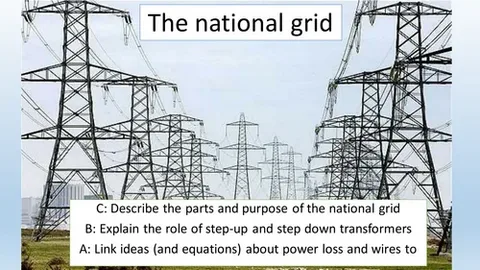
Large transmission towers carrying high-voltage lines are among the most recognizable parts of the electricity network.
3. Electricity Transmission
Transmission is the process of moving electricity from generating facilities to areas where it will eventually be used.
This stage involves high-voltage overhead lines, underground cables, and large substations.
Transmission networks connect different regions and allow electricity to move between locations when local generation is not sufficient to meet demand.
For example, electricity generated by a wind farm in a coastal region may be transported inland to supply cities and industrial areas.
Transmission infrastructure must be carefully planned because electricity demand changes throughout the day and across different seasons.
4. Substations and Voltage Transformation
Substations are important facilities within the National Grid.
They contain transformers, circuit breakers, switches, monitoring systems, and protective equipment.
One major function of a substation is to reduce electricity voltage before it moves into regional distribution networks.
Substations also help operators control electricity flows, isolate damaged equipment, and maintain the stability of the network.
Without substations, delivering electricity safely and efficiently to different areas would be extremely difficult.
5. Electricity Distribution
After electricity reaches a suitable voltage, it enters distribution networks.
Distribution systems carry electricity from substations to residential neighborhoods, offices, factories, shops, and other facilities.
Unlike major transmission lines, distribution lines generally operate at lower voltage levels.
Before electricity reaches a household, additional transformers reduce the voltage to the level required by domestic electrical systems.
The electricity then enters the property through a service connection and passes through the consumer’s electrical meter.
6. Electricity Consumption
The final stage is electricity consumption.
Consumers use electricity for lighting, heating, cooling, cooking, communication, entertainment, manufacturing, and countless other activities.
Although customers generally see only their electricity meters and bills, their supply depends on the successful operation of the entire electricity network.
Main Components of the National Grid
The National Grid contains several types of infrastructure, each responsible for a specific function.
Understanding these components makes it easier to see how the entire system operates.
Transmission Towers
Northern Ireland’s future energy
Transmission towers support overhead electrical conductors and keep high-voltage cables safely separated from the ground and surrounding structures.
They are usually made from strong steel structures designed to withstand wind, weather, and mechanical stress.
Their height and construction depend on the voltage level, geographical conditions, and engineering requirements.
Power Lines
Power lines carry electricity between generating facilities, substations, and distribution networks.
There are two main types:
- Overhead power lines, which use conductors supported by towers or poles.
- Underground cables, which are installed beneath the ground.
Overhead lines are often less expensive to construct and maintain, while underground cables can be useful in densely populated or environmentally sensitive locations.
However, underground systems can be more expensive to install and repair.
Transformers
Transformers change electrical voltage levels.
Step-up transformers increase voltage for long-distance transmission, while step-down transformers reduce voltage for distribution and consumer use.
They are essential for improving transmission efficiency and ensuring electricity reaches customers at appropriate voltage levels.
Substations
Substations serve as control and connection points throughout the electricity network.
They allow operators to manage electricity flows and isolate sections of the system when maintenance or emergency repairs are necessary.
Some substations are located near power stations, while others are positioned close to cities and industrial areas.
Control Centers
Electricity networks require continuous monitoring.
Control centers use advanced computer systems, communication technologies, and operational data to monitor electricity generation and transmission.
Operators observe electricity demand, equipment conditions, network performance, and possible faults.
When problems occur, control teams can coordinate responses to help maintain the electricity supply.
Smart Grid Equipment
Modern electricity networks increasingly use digital technology.
Smart meters, automated switches, sensors, and communication systems provide information that helps operators understand what is happening across the network.
These technologies can improve efficiency, support renewable energy integration, and help identify faults more quickly.
Why Is the National Grid Important?
The National Grid is important because modern society depends on reliable electricity.
A disruption to electricity infrastructure can affect homes, hospitals, transportation, businesses, communication systems, and essential public services.
The grid provides several major benefits.
Reliable Electricity Supply
One of the most important responsibilities of an electricity grid is maintaining a dependable supply.
Electricity demand changes throughout the day. People use more electricity at certain times, especially during busy morning and evening periods.
The grid connects multiple electricity sources and allows operators to balance available generation with demand.
This helps reduce the risk of shortages and supports continuity of service.
Supporting Economic Growth
Businesses and industries need electricity to operate machinery, computers, manufacturing equipment, refrigeration systems, and communication networks.
A reliable electricity supply allows companies to operate efficiently and serve customers.
Large industrial facilities often require substantial amounts of electrical power. Without a strong transmission network, supplying these facilities would be much more difficult.
The National Grid therefore supports economic development by connecting energy resources with commercial and industrial users.
Connecting Different Regions
Electricity generation and electricity consumption do not always occur in the same locations.
A country may produce significant amounts of renewable electricity in rural or coastal areas, while its largest cities are located far away.
The transmission network connects these locations and allows electricity to move between regions.
This geographic connection is particularly important when renewable energy production varies according to weather conditions.
Supporting Essential Services
Hospitals, emergency response facilities, water treatment plants, and communication networks depend on electricity.
Although many essential facilities have backup generators and emergency power systems, the normal electricity supply remains extremely important.
A well-maintained grid helps support the operation of these services.
Encouraging Energy Innovation
Modern electricity networks make it possible to introduce new energy technologies.
These include electric vehicle charging stations, rooftop solar panels, battery storage systems, and smart energy management equipment.
As technology develops, the National Grid must adapt to accommodate new patterns of electricity production and consumption.
National Grid and Renewable Energy
Renewable energy has become an important part of electricity generation in many countries.
Wind, solar, hydroelectric, and other renewable technologies can reduce dependence on fossil fuels and support efforts to lower greenhouse gas emissions.
However, renewable energy also creates new challenges for electricity networks.
Unlike traditional power stations that can often be scheduled according to demand, wind and solar generation depend heavily on weather conditions.
For example, solar panels produce electricity during daylight hours, while wind turbines generate more electricity when wind conditions are suitable.
The National Grid must therefore become more flexible to manage changing generation levels.
Integrating Wind Power
Wind energy is an important renewable electricity source.
Large wind farms may be located offshore or in areas with strong and consistent wind conditions.
The electricity they produce must be connected to transmission networks so it can reach homes and businesses.
Offshore wind projects often require specialized cables that carry electricity from turbines to onshore substations.
As offshore wind capacity increases, transmission infrastructure must also expand.
Connecting Solar Energy
Solar energy is generated through photovoltaic panels that convert sunlight into electricity.
Large solar farms can produce significant amounts of electricity, while smaller rooftop systems allow individual households and businesses to generate some of their own power.
However, solar generation varies throughout the day.
Electricity networks must manage these variations while maintaining the balance between generation and demand.
Battery storage and improved forecasting can help address some of these challenges.
Battery Storage Systems
Battery storage is becoming increasingly important for modern electricity networks.
Batteries can store electricity when production is high and release it when demand increases or renewable generation decreases.
This makes them useful for managing fluctuations in renewable electricity production.
Large battery installations can also provide services that help stabilize electricity networks.
The Role of Hydroelectric Energy
Hydroelectric power stations use flowing water to generate electricity.
Some hydroelectric facilities can adjust their electricity production relatively quickly, making them useful for balancing supply and demand.
Pumped-storage hydroelectric systems can also store energy by pumping water to a higher reservoir when electricity is available and releasing it through turbines when electricity is needed.
What Is the Difference Between National Grid and Distribution Networks?
People sometimes use the terms transmission network, distribution network, and National Grid as if they mean exactly the same thing.
However, these terms describe different parts of the electricity system.
The transmission network carries large quantities of electricity over long distances, usually at high voltage.
The distribution network delivers electricity from regional substations to individual consumers.
The National Grid may refer to the wider interconnected system or, in some countries, a particular company responsible for operating parts of the electricity infrastructure.
For example, in Great Britain, National Grid’s electricity transmission business and the regional distribution network operators have different responsibilities.
Transmission operators manage the high-voltage network, while distribution operators maintain the local infrastructure that supplies homes and businesses.
Understanding this distinction is useful when researching electricity companies, reporting power problems, or learning how energy markets operate.
National Grid in the United Kingdom
The United Kingdom has a complex electricity system that connects power generation with consumers throughout Great Britain.
The National Grid is particularly important in coordinating electricity transmission and supporting the transition toward cleaner energy.
The electricity network connects power stations, renewable energy facilities, industrial areas, and major population centers.
As the country increases its use of renewable energy, transmission infrastructure must develop to accommodate new generating locations.
Offshore wind farms are especially important because many are located far from major electricity demand centers.
The UK electricity system also uses interconnectors that connect its electricity network with neighboring countries.
These connections allow electricity to flow between different markets when conditions and commercial arrangements permit.
Electricity Transmission in Great Britain
The high-voltage transmission system carries electricity across England and Wales, with separate transmission arrangements and network operators in Scotland.
National Grid Electricity Transmission owns and maintains the high-voltage transmission network in England and Wales.
The wider system includes connections with Scottish networks and international electricity interconnectors.
This structure helps move electricity between different regions and supports the operation of the national electricity system.
The Role of National Grid ESO and NESO
Electricity system operation in Great Britain has evolved over time.
The Electricity System Operator previously operated within National Grid and became an independent organization, National Energy System Operator (NESO), in October 2024.
NESO is responsible for operating the electricity system and planning the wider energy system in Great Britain.
This distinction matters because the company operating transmission infrastructure and the organization responsible for balancing and operating the electricity system do not have identical responsibilities.
National Grid in the United States
The United States has a large and interconnected electricity system.
Unlike countries with a single national electricity network operator, the US electricity system includes many utilities, regional transmission organizations, independent system operators, and other market participants.
National Grid plc is also a major energy company with operations in the United Kingdom and the northeastern United States.
Its US operations have included electricity and gas distribution activities in several states.
The American electricity system is made up of different regional networks, many of which are interconnected.
These connections allow electricity to move across state boundaries and support regional electricity markets.
Regional Electricity Networks
The United States has several major electricity regions.
Some are managed through regional transmission organizations, which coordinate electricity markets and transmission operations.
These organizations help manage electricity flows, maintain reliability, and coordinate generation across participating areas.
The structure of the American electricity system reflects its size, geography, regulatory environment, and history of utility development.
National Grid as an Energy Company
It is important to distinguish between the general term national grid and the company called National Grid plc.
The company operates energy infrastructure and provides electricity and gas network services in certain markets.
People searching for National Grid may therefore be looking for different types of information, such as electricity infrastructure, customer services, company information, or energy bills.
Understanding the context can help identify the correct information.
How Does National Grid Balance Electricity Supply and Demand?
Electricity systems require a continuous balance between electricity generation and consumption.
Unlike many other products, electricity cannot simply be stored in unlimited quantities at a low cost.
Although battery systems, pumped-storage facilities, and other technologies can store energy, large electricity networks still require careful real-time management.
If electricity demand increases, the system must respond by making additional generation or stored energy available.
If generation exceeds demand, operators must manage the excess electricity.
Electricity Demand Forecasting
Electricity operators use forecasting tools to estimate how much electricity consumers will need.
Forecasting systems consider factors such as:
- Weather conditions.
- Time of day.
- Day of the week.
- Seasonal patterns.
- Industrial activity.
- Historical electricity consumption.
- Expected renewable energy production.
Accurate forecasts help operators plan generation and maintain a reliable supply.
Frequency Management
Electricity networks operate at a specified frequency.
In Great Britain and many other countries, the standard frequency is 50 hertz. In the United States, it is generally 60 hertz.
Frequency changes can indicate an imbalance between electricity generation and demand.
If generation is insufficient, frequency can fall. If generation exceeds demand, frequency can rise.
Operators use various balancing services and control mechanisms to maintain frequency within acceptable operating limits.
Managing Peak Demand
Peak demand refers to periods when electricity consumption reaches particularly high levels.
For example, electricity use may increase during cold winter evenings when households use heating and lighting.
In hot regions, air conditioning can create substantial demand during summer afternoons.
Electricity operators prepare for these periods by forecasting consumption and ensuring sufficient resources are available.
Demand-response programs can also encourage customers to adjust their electricity use when the system is under pressure.
What Is a Smart National Grid?
A smart grid is an electricity network that uses digital technologies to improve monitoring, communication, automation, and energy management.
Traditional electricity networks were designed primarily for electricity to move from large power stations toward consumers.
Modern networks must handle more complex electricity flows because households and businesses can also generate and store energy.
Smart grid technologies help manage this complexity.
Smart Meters
Heat Pump Electricity Usage: kWh by Home Size | NuWatt Energy | NuWatt Energy
Smart meters record electricity consumption and communicate readings through digital systems.
They can help consumers understand their electricity usage and reduce the need for manual meter readings.
Depending on the available services and tariff arrangements, smart meters may also provide access to more flexible electricity pricing.
Automated Monitoring
Sensors and digital monitoring systems can provide information about voltage levels, equipment performance, and network conditions.
Operators can use this information to identify problems and make decisions more quickly.
Automation can also help isolate faults and restore electricity to unaffected areas.
Two-Way Electricity Flows
Modern electricity networks increasingly support two-way electricity flows.
For example, a home with rooftop solar panels may generate more electricity than it consumes during the day.
The excess electricity may be exported to the local network, depending on the connection and applicable arrangements.
This creates a more decentralized energy system in which consumers can become electricity producers as well.
Artificial Intelligence in Energy Management
Artificial intelligence and machine learning are becoming useful tools in electricity operations.
These technologies can help analyze large amounts of operational information, forecast electricity demand, and identify unusual equipment behavior.
They may also support predictive maintenance by helping operators identify equipment that could require attention before a failure occurs.
However, AI does not replace the need for qualified engineers, operational expertise, and reliable infrastructure.
Challenges Facing the National Grid
Although electricity networks have developed significantly over the years, they face several challenges.
These challenges are becoming more important as electricity consumption increases and energy systems transition toward cleaner technologies.
Aging Infrastructure
Some electricity infrastructure has been operating for decades.
Transmission towers, transformers, cables, and substations require regular inspections and maintenance.
Older equipment may need replacement or upgrades to meet modern electricity requirements.
Maintaining aging infrastructure is a major responsibility for electricity network operators.
Increasing Electricity Demand
Electricity demand is expected to change as more activities become electrified.
Electric vehicles, electric heating, industrial electrification, and data centers can increase electricity consumption.
This creates a need for additional generation capacity and stronger transmission and distribution networks.
Renewable Energy Variability
Wind and solar power depend on weather conditions.
Electricity production may change quickly when wind speeds or sunlight levels change.
Grid operators must use forecasting, storage, flexible generation, and other balancing resources to manage these variations.
Extreme Weather
Storms, floods, heatwaves, snow, and strong winds can damage electricity infrastructure.
Extreme temperatures can also increase electricity demand and place additional pressure on electrical equipment.
Climate resilience is therefore becoming an important consideration when designing and maintaining transmission networks.
Cybersecurity Threats
Modern electricity networks depend increasingly on digital systems and communication technologies.
These systems can create cybersecurity risks if they are not properly protected.
Energy companies must use security controls, monitoring systems, staff training, and incident-response procedures to reduce potential threats.
High Infrastructure Costs
Building transmission lines, underground cables, substations, and energy storage facilities requires substantial investment.
Projects may also involve complex planning approvals, environmental assessments, land access, and public consultation.
These factors can affect how quickly electricity infrastructure can be expanded.
How Is Electricity Infrastructure Maintained?
Maintenance is essential for keeping the National Grid safe and reliable.
Electricity companies use several approaches to inspect, repair, and upgrade network equipment.
Regular Inspections
Engineers and technical teams inspect transmission towers, conductors, substations, transformers, and other equipment.
Inspections may involve ground-based assessments, specialized vehicles, helicopters, and drones.
The purpose is to identify physical damage, corrosion, overheating, vegetation interference, or other potential problems.
Preventive Maintenance
Preventive maintenance involves servicing equipment before it develops a serious fault.
This may include cleaning electrical components, testing protective systems, checking transformer conditions, and replacing worn parts.
Preventive maintenance can reduce unexpected breakdowns and improve equipment life.
Emergency Repairs
Sometimes equipment fails unexpectedly because of weather events, mechanical damage, or other incidents.
Emergency response teams work to identify the cause, isolate affected equipment, and restore service safely.
Depending on the nature of the incident, repairs may take a short time or require more extensive work.
Infrastructure Upgrades
Electricity networks must evolve as technology and electricity demand change.
Upgrades may involve replacing transformers, installing new cables, improving substations, increasing transmission capacity, or introducing advanced monitoring equipment.
These improvements help prepare the grid for future energy requirements.
National Grid and Electric Vehicles
Electric vehicles are becoming increasingly common in many countries.
As more people switch from petrol and diesel vehicles to electric alternatives, electricity networks must support a growing number of charging points.
Charging an electric vehicle requires electricity, and large numbers of vehicles charging at the same time can create additional demand.
Grid operators must consider where charging stations are installed, how much electricity they require, and when drivers are most likely to use them.
Home Charging
Home charging allows electric vehicle owners to recharge their vehicles overnight or whenever convenient.
Smart charging systems can adjust charging times to avoid periods of high electricity demand.
Public Charging Stations
Public charging stations are installed at locations such as shopping centers, highways, workplaces, and parking facilities.
High-power charging stations can require substantial electrical capacity.
As their numbers increase, local electricity networks may need upgrades.
Vehicle-to-Grid Technology
Vehicle-to-grid technology allows compatible electric vehicles to send stored electricity back into the electricity network.
In theory, large groups of connected vehicles could provide additional flexibility during periods of high demand.
However, this technology depends on compatible vehicles, charging equipment, network arrangements, and suitable commercial programs.
How Does the National Grid Affect Electricity Bills?
The National Grid and electricity networks are connected to the overall cost of delivering electricity.
However, an electricity bill usually contains several different components.
These may include:
- Electricity generation costs.
- Transmission and distribution charges.
- Supplier operating costs.
- Government taxes and policy-related charges.
- Metering and other applicable service costs.
The exact structure depends on the country and its electricity market.
Transmission and distribution infrastructure requires investment, maintenance, and operation. These costs are generally recovered through regulated charges or other approved arrangements.
However, it would be incorrect to assume that every change in an electricity bill is directly caused by the National Grid.
Fuel prices, electricity market conditions, government policies, supplier charges, and other factors can also affect the final amount customers pay.
Consumers can often reduce their electricity costs by improving energy efficiency and avoiding unnecessary consumption.
Ways Consumers Can Use Electricity More Efficiently
Although individual consumers do not operate the National Grid, their electricity habits influence overall demand.
Small improvements across millions of households can make a meaningful difference.
Switch Off Unused Appliances
Leaving electrical devices running unnecessarily increases energy consumption.
Switching off lights, televisions, computers, and other appliances when they are not needed can help reduce electricity use.
Choose Energy-Efficient Equipment
Modern energy-efficient appliances can perform the same tasks while using less electricity.
When purchasing refrigerators, air conditioners, washing machines, or lighting products, consumers should compare energy ratings and expected operating costs.
Improve Home Insulation
Poor insulation allows heat to escape during winter and enter during summer.
Improving insulation can reduce the need for heating and cooling, which are often major sources of household electricity consumption.
Use LED Lighting
LED bulbs generally consume less electricity than traditional incandescent bulbs and have a longer operating life.
Replacing older lighting with LEDs is a relatively simple way to improve household energy efficiency.
Manage Heating and Cooling
Air conditioners and electric heaters can consume substantial amounts of electricity.
Using suitable temperature settings, maintaining equipment, and improving ventilation can help control energy use.
National Grid and Energy Security
Energy security means having access to reliable and affordable energy.
A strong electricity transmission network contributes to energy security by connecting different electricity sources and allowing power to move between regions.
If one generating facility experiences a problem, other available generation sources may help support electricity demand.
International electricity interconnectors can also provide additional flexibility by allowing countries to exchange electricity.
However, energy security requires more than transmission infrastructure.
It also depends on fuel availability, generating capacity, energy storage, system planning, equipment reliability, and effective regulation.
Countries must consider these factors when developing long-term energy strategies.
The Future of the National Grid
The electricity network of the future will need to be more flexible, intelligent, and capable of supporting different types of energy resources.
Several developments are likely to influence how national electricity grids evolve.
Expansion of Renewable Energy
Renewable electricity generation is expected to remain an important part of energy development.
As more wind and solar facilities are connected, transmission networks will need to transport electricity from new generating locations.
This may require additional transmission lines, upgraded substations, and improved network planning.
Advanced Energy Storage
Battery technology is developing rapidly.
Larger and more efficient storage systems could help balance electricity supply and demand, particularly when renewable generation changes throughout the day.
Other storage technologies, including pumped hydro and thermal energy storage, may also contribute to future electricity systems.
Digital Electricity Networks
Digital monitoring, automated controls, and advanced forecasting will continue to influence grid operations.
These technologies can provide better information about electricity flows and help operators respond to changing conditions.
Greater Electrification
Transportation, heating, and some industrial processes are gradually moving toward electricity-based technologies.
This trend could increase electricity demand and create new requirements for transmission and distribution networks.
Stronger International Connections
Countries may continue developing cross-border electricity connections.
These interconnectors can support electricity trading, improve regional flexibility, and provide access to different generation resources.
More Consumer Participation
Consumers are increasingly able to generate, store, and manage electricity.
Rooftop solar panels, home batteries, smart meters, and electric vehicles may allow households to participate more actively in the energy system.
This will require electricity networks that can handle electricity flows in multiple directions.
National Grid Jobs and Career Opportunities
The electricity sector offers career opportunities for people with different educational backgrounds and technical skills.
Building, maintaining, and operating an electricity network requires engineers, technicians, planners, electricians, data specialists, project managers, and safety professionals.
Electrical Engineers
Electrical engineers work on power systems, transformers, substations, protection equipment, and electricity network design.
They help ensure electrical infrastructure operates safely and efficiently.
Power System Engineers
Power system engineers study electricity generation, transmission, distribution, and system stability.
Their work may involve electricity demand forecasting, network modeling, and system planning.
Network Technicians
Network technicians help install, inspect, test, and maintain electrical infrastructure.
Their responsibilities may include working with cables, substations, protective equipment, and monitoring systems.
Project Managers
Large electricity infrastructure projects require careful planning and coordination.
Project managers oversee budgets, schedules, contractors, safety requirements, and project delivery.
Data and Cybersecurity Specialists
As electricity networks become more digital, professionals with expertise in data analysis, software, communication systems, and cybersecurity are becoming increasingly important.
People interested in energy careers can explore electrical engineering programs, technical training, apprenticeships, and industry qualifications.
How Does the National Grid Support Sustainable Development?
Sustainable development involves meeting current needs without compromising the ability of future generations to meet their own needs.
Reliable electricity infrastructure supports this objective in several ways.
It helps connect renewable energy resources, improves access to modern energy services, and supports economic activity.
Electricity networks can also help reduce energy waste through better monitoring and more efficient transmission technologies.
However, electricity infrastructure itself must be developed responsibly.
Transmission projects can affect land use, wildlife habitats, landscapes, and local communities.
Careful environmental planning and consultation are therefore important parts of responsible network development.
National Grid vs. Power Stations: Understanding the Difference

A power station and a National Grid network perform different functions.
A power station produces electricity.
The National Grid transports electricity from generating facilities toward areas where it is needed.
For example, a wind farm may generate electricity using wind turbines. The electricity then travels through connection cables and transmission infrastructure before reaching substations and local distribution networks.
Without generating facilities, the grid would have no electricity to transport.
Without the grid, large generating facilities would have difficulty delivering electricity to customers located far away.
Both are essential parts of the modern energy system.
What Happens When Part of the National Grid Fails?
Electricity networks are designed with protection systems that help reduce the impact of equipment failures.
When a fault occurs, protective devices may automatically disconnect the affected section to prevent further damage.
Depending on the network design, electricity may be redirected through alternative routes.
Control center operators monitor the situation and coordinate appropriate responses.
If a fault affects a large part of the network, customers may experience power interruptions.
Restoration work depends on the location of the fault, the equipment involved, weather conditions, and the availability of repair teams.
Large electricity networks are generally designed with redundancy and protective measures to improve resilience, although no system can guarantee uninterrupted service under every circumstance.
National Grid and Developing Countries
Electricity infrastructure is especially important in developing countries where demand is increasing and access to reliable electricity may remain limited in some areas.
Population growth, industrial development, urban expansion, and technology adoption all increase the need for dependable electricity.
Countries such as Pakistan face important challenges related to generation capacity, transmission constraints, distribution losses, electricity affordability, and infrastructure investment.
A stronger national electricity network can help connect generating facilities with cities, industrial zones, agricultural areas, and rural communities.
Electricity Transmission in Pakistan
Pakistan’s electricity system includes major generating facilities, high-voltage transmission networks, and regional distribution companies.
The National Transmission and Despatch Company (NTDC) has historically played an important role in the country’s transmission system.
The national electricity network transports power from generating stations toward distribution companies, which deliver electricity to consumers.
Pakistan also has growing renewable energy potential, including solar, wind, and hydropower resources.
Expanding and modernizing transmission infrastructure is important for making better use of these resources.
Solar Energy and Pakistan’s Electricity Network
Solar power has attracted increasing interest in Pakistan because of the country’s substantial sunlight availability.
Households, commercial buildings, and industrial facilities can install solar panels to generate electricity.
However, large-scale solar adoption also creates technical requirements for distribution and transmission networks.
Grid operators must manage changing electricity flows, voltage conditions, and periods of high renewable generation.
Improved infrastructure and suitable energy policies can help integrate more renewable energy into the national electricity system.
Common Misunderstandings About the National Grid

There are several common misunderstandings about how electricity networks work.
Misunderstanding 1: The National Grid produces all electricity.
The grid itself is primarily responsible for transporting and managing electricity. Power stations and renewable energy facilities generate the electricity.
Misunderstanding 2: Electricity travels through only one route.
Modern electricity networks contain interconnected lines and substations. Electricity can travel through different available paths depending on network conditions.
Misunderstanding 3: Renewable energy does not need traditional infrastructure.
Wind and solar facilities still require connections, substations, transmission systems, and distribution networks.
Misunderstanding 4: Electricity companies and grid operators are always the same organization.
Different organizations may be responsible for generation, transmission, distribution, electricity trading, and system operation.
Misunderstanding 5: A stronger grid automatically makes electricity cheaper.
Improved infrastructure can support efficiency and reliability, but electricity prices also depend on generation costs, market conditions, investment, and government policies.
Frequently Asked Questions About National Grid

1. What is the National Grid in simple words?
The National Grid is an interconnected electricity network that transports electricity from power stations and renewable energy facilities to homes, businesses, and other consumers.
2. What is the main purpose of the National Grid?
Its main purpose is to move electricity safely and efficiently across different regions while supporting a reliable balance between electricity supply and demand.
3. Does the National Grid generate electricity?
No. The electricity is generated by power stations, wind farms, solar facilities, and other generating sources. The grid transports that electricity.
4. Why does electricity travel at high voltage?
High-voltage transmission helps reduce energy losses when electricity travels over long distances.
5. What are the main components of the National Grid?
Major components include transmission towers, power lines, transformers, substations, control centers, and monitoring systems.
6. What is the difference between transmission and distribution?
Transmission carries large amounts of electricity over long distances at high voltage. Distribution delivers electricity from substations to individual consumers.
7. Is National Grid a company?
National Grid plc is an energy infrastructure company operating in the United Kingdom and the United States. However, the expression national grid can also describe a country’s wider interconnected electricity network.
8. How does renewable energy connect to the National Grid?
Renewable energy facilities connect through suitable electrical infrastructure, including cables, transformers, substations, and transmission lines.
9. What is a smart grid?
A smart grid is an electricity network that uses digital technologies, sensors, communication systems, and automation to improve monitoring and management.
10. Can the National Grid store electricity?
Transmission networks do not generally store electricity themselves. However, connected battery systems, pumped-storage facilities, and other energy storage technologies can store electricity for later use.
11. Why does electricity demand change throughout the day?
Electricity demand changes because people and businesses use different amounts of electricity at different times. Weather, heating, cooling, industrial activity, and daily routines all influence consumption.
12. What happens if the National Grid experiences a fault?
Protective systems may disconnect the affected equipment, while operators coordinate repairs and restoration. Depending on the size and location of the problem, some customers may experience an interruption.
13. Does the National Grid support electric vehicles?
Yes. Electricity networks provide the infrastructure needed to supply home chargers, workplace charging facilities, and public electric vehicle charging stations.
14. Why does the National Grid need regular maintenance?
Maintenance helps identify damaged equipment, reduce unexpected failures, improve safety, and extend the useful life of electricity infrastructure.
15. What is the future of the National Grid?
Future electricity networks are expected to use more renewable energy, battery storage, digital monitoring, automation, electric vehicle connections, and advanced electricity management technologies.
Final Thoughts
The National Grid is one of the most important parts of modern energy infrastructure. It connects electricity generation with the people, businesses, and services that depend on a continuous power supply.
From large transmission towers and substations to advanced monitoring systems and renewable energy connections, every component contributes to the operation of the electricity network.
As electricity demand grows and countries move toward cleaner energy sources, the National Grid will face new challenges. Aging infrastructure, changing consumption patterns, extreme weather, cybersecurity risks, and renewable energy integration will all influence its future development.
At the same time, improvements in battery storage, smart meters, digital technologies, and transmission infrastructure offer opportunities to create more flexible and efficient electricity systems.
Understanding the National Grid is therefore not just a technical subject. It helps explain how modern communities function, how energy reaches consumers, and why investment in reliable electricity infrastructure matters for economic growth and sustainable development.
A well-planned and properly maintained electricity network will remain essential as the world moves toward a more connected, electrified, and sustainable future.














Leave a Reply