
Ask a room of football fans a simple question – who was the first Black NFL quarterback? – and you will get at least three different answers, all of them said with total confidence. One person says Doug Williams. Another says Marlin Briscoe. Someone older might say Willie Thrower. And a real history buff will shake his head and say Fritz Pollard, 1923, look it up.
Here is the thing. They are all kind of right.
That sounds like a cop-out, but it is actually the most honest answer to this keyword. ‘First’ depends on what you mean. First to play the position at all? That is Pollard. First to play it in the modern NFL? Thrower. First to start a game in the modern era? Briscoe. First to open a season as the starter and win a playoff game? James Harris. First to start and win a Super Bowl? Doug Williams, and it is not even close.
This article walks through all five, in order, with the dates and the games. No myths, no inflated claims, and no pretending one man did it all alone. Each of them broke a different barrier, and each barrier existed for a reason that had nothing to do with talent.
The quick answer, before the history
If you only have thirty seconds, here it is. Fritz Pollard played quarterback for the Hammond Pros in 1923, which makes him the first Black quarterback in NFL history. He did it in a very different game – small towns, leather helmets, players who played both ways and a position that did not look much like the quarterback job we know today.
Willie Thrower is the first Black quarterback of the modern NFL. On October 18, 1953, he came off the bench for the Chicago Bears against the San Francisco 49ers and completed 3 of 8 passes for 27 yards. A short appearance. A huge moment.
Marlin Briscoe is the first Black quarterback to start a game in modern professional football. He did it on October 6, 1968, for the Denver Broncos of the American Football League, the AFL, which later merged with the NFL.
James Harris, a year later, became the first Black quarterback to start a season opener, in 1969 for the Buffalo Bills. In 1974, with the Los Angeles Rams, he became the first to start and win a playoff game.
And Doug Williams closed the last big door on January 31, 1988, when he started Super Bowl XXII for Washington, threw for 340 yards and four touchdowns, and walked away with the MVP award and a 42-10 win over Denver.
Five men, five firsts, sixty-five years from the first one to the last. That gap alone tells you most of the story.
Why this question is more confusing than it looks
Most ‘first’ questions in sport have a clean answer. First man on the moon, first Super Bowl winner, first 50-goal season – done. This one does not, and there are three reasons why.
First, early football was messy. In the 1920s the quarterback was not yet the field general throwing forty times a game. Teams ran from single-wing and T formations, positions blurred, and the man lined up at quarterback on one play might be a halfback on the next. Pollard was listed mainly as a back. He ran, he received, he returned kicks – and yes, he played quarterback and called the offence. Modern record books had to go back and piece that together.
Second, the league itself split. From 1960 to 1969 the AFL ran as a rival to the NFL before the merger created the league we know now. Briscoe and Harris both made their first starts in the AFL. Some older lists, written only about the NFL, quietly skipped them. That is how two true answers ended up competing with each other for decades.
Third, and most importantly, there is a hole in the middle of the story. Black players were pushed out of the league in the late 1920s and then formally shut out for more than a decade. You cannot have a second, third or fourth Black quarterback when you are not allowed to have any Black players at all. The timeline breaks because the opportunity broke.
Fritz Pollard: the first Black NFL quarterback, in 1923
Frederick Douglass Pollard – Fritz to everyone – was small for football in any era. About 5 feet 9 inches, around 165 pounds. What he had was speed nobody could coach and balance nobody could knock over easily. Walter Camp, the man often called the father of American football, called him one of the greatest runners he had ever seen.
At Brown University, Pollard became the first Black running back named to Camp’s All-America team and played in the 1916 Rose Bowl, the first Black player to appear in that game. Even that trip showed what he was up against. The team hotel in Pasadena tried to refuse him a room. His coaches insisted. He got the room, played the game, and kept moving.
In 1920 Pollard joined the Akron Pros in the new American Professional Football Association, the league renamed the NFL two years later. Akron went unbeaten and won the league’s first championship. Pollard and Bobby Marshall were the first two Black players in the league. In 1921 Pollard also became its first Black head coach, as player-coach at Akron – sixty-eight years before the league would have another Black head coach in the modern era.
Then came the quarterback part. In 1923, playing for the Hammond Pros, Pollard played quarterback. That is the appearance historians point to when they call him, correctly, the first Black quarterback in NFL history. It was not a long, celebrated stint under centre. It did not need to be. He got there first, in an era when the very idea was treated as impossible.
Pollard played until 1926. By then the door he had walked through was already closing behind him.
The lost years: when the league shut Black players out
This is the part of the story that used to get skipped in short articles, and it is the part that explains everything else. After the mid-1920s, Black players began disappearing from NFL rosters – not because they suddenly stopped being good enough, but because owners stopped signing them. By the early 1930s there were seasons with only one or two Black players in the entire league, and a player like Joe Lillard of the Chicago Cardinals, who also took snaps at quarterback in 1932 and 1933, was gone soon after.
From 1934 the exclusion became complete. No Black players appeared in the NFL until after the Second World War, when the league reintegrated in 1946 – a year before Jackie Robinson broke baseball’s colour line. Think about that timeline for a second. Pollard plays quarterback in 1923. The next Black quarterback to appear in the NFL does not arrive for another thirty years.
A whole generation of talent simply never got a chance. College stars played in Canada, in semi-pro football, or nowhere at all. When people ask why the ‘first Black quarterback’ debate stretches across so many decades, this ban is the honest answer. The line did not move slowly because progress is slow. It barely moved because it was held in place.
Willie Thrower: the first Black quarterback of the modern NFL
Willie Thrower had, as more than one writer has noted, the perfect surname for his position. He also had huge hands and an arm that teammates at Michigan State talked about for years – he was used in practice just to launch the ball downfield on kickoff drills because nobody else could throw it that far, that accurately.
Thrower had already broken one barrier before the NFL. At Michigan State he became the first Black quarterback in the Big Ten, and he was part of the Spartans’ 1952 national championship team. He went undrafted in 1953, which tells its own story, and signed a one-year deal with the Chicago Bears as backup to George Blanda, a future Hall of Famer.
On October 18, 1953, at Wrigley Field, Blanda was struggling against the San Francisco 49ers and the Bears trailed. Coach George Halas sent Thrower in. He completed 3 of 8 passes for 27 yards, with one interception, before Blanda returned. Chicago lost the game, Thrower played only once more that season, and he was released at the end of the year. His entire NFL career, on paper, is eight pass attempts.
And yet Warren Moon, in his Pro Football Hall of Fame speech decades later, thanked Thrower by name. That is the measure of those eight attempts. Thrower himself put it plainly in later years – he felt like the Jackie Robinson of football. The comparison is not perfect, because Robinson got a full career to prove himself and Thrower did not. In some ways that makes Thrower’s footnote status sadder, not smaller. He proved the moment could happen. The league then waited fifteen more years before it let a Black quarterback start a game.
A name in between: Charlie Brackins and the quiet 1950s
Between Thrower and Briscoe, one more name deserves a line, because without it the gap looks emptier than it was. Charlie Brackins, from Prairie View A&M, was drafted by the Green Bay Packers in 1955 and appeared in games that season, one of the very few Black quarterbacks to take snaps in the NFL in the 1950s. He did not start, he did not get a long run, and his career was over quickly.
That was the pattern of the decade. A Black quarterback might make a roster. He might get a few snaps in a game already decided. What he almost never got was the job – the week of practice with the starters, the game plan built around him, the second chance after a bad Sunday. The barrier after Thrower was not about getting into the league. It was about being trusted to run a team.
Marlin Briscoe: the first Black quarterback to start a modern pro game
Marlin Briscoe’s story is the one that makes most fans angry, and honestly, it should. Denver drafted him in the 14th round in 1968 – as a cornerback. Briscoe, who had set records as a quarterback at Omaha University, told the Broncos he would go home and become a teacher if they would not at least let him try out at quarterback. It was not a bluff he enjoyed making. It was the only leverage he had.
Denver agreed to the tryout. Then, on September 29, 1968, starting quarterback Steve Tensi broke his collarbone against the Boston Patriots. Briscoe came in during the fourth quarter, completed his first pass for 22 yards, and led an 80-yard touchdown drive, finishing it with a 12-yard run himself. One week later, on October 6, he started against Cincinnati and Denver won 10-7. Nicknamed ‘The Magician’, he started five games that season, threw for 1,589 yards and 14 touchdown passes – a Broncos rookie record that stood until 2024 – and ran for 308 yards and three more scores. He finished runner-up for AFL Rookie of the Year.
Now the other half of the story. The following season, Denver would not let him compete for the quarterback job. Not lost the job in a fair contest – never given the contest. Briscoe asked for his release, moved to Buffalo, and rebuilt himself as a wide receiver so successfully that he made the Pro Bowl in 1970 and later won two Super Bowls as a receiver with Miami, including the famous undefeated 1972 season. A great career. Just not at the position he had already proved he could play.
James Harris: the first to open a season, and the first to win in the playoffs
If Briscoe proved a Black quarterback could start a game, James ‘Shack’ Harris proved one could be handed the team. The difference matters. A spot start is an emergency. A season opener is a decision, made in the calm of training camp, that says this is our leader.
Harris came out of Grambling State, where he played for the legendary coach Eddie Robinson and won three conference championships. In the 1969 draft, teams told him the same thing they told Briscoe – switch position and you will be picked high. Harris refused, slid to the eighth round, and nearly quit football altogether to become a teacher. Robinson talked him out of it, in terms Harris never forgot: if he did not try, he could not come back and blame race for it. Harris went to Buffalo seventh on the depth chart.
On September 14, 1969, Harris started the Buffalo Bills’ season opener – the first Black quarterback to start a season opener in the AFL or NFL. His best years came later, with the Los Angeles Rams. In 1974, promoted to starter mid-season, he tore up San Francisco in his first Rams start, led Los Angeles to the division title and its first playoff win since 1951, and finished that season as the first Black quarterback to start and win an NFL playoff game, to play in the Pro Bowl, and to be named Pro Bowl MVP.
His reward, over the following seasons, was to watch the Rams keep bringing in other quarterbacks to replace him despite a winning record as a starter – and to play, at one point, under armed guard after a credible death threat. Harris’s story is usually told as a triumph, and it was. It was also exhausting in a way his white counterparts simply never had to be.
The 1970s grind: Joe Gilliam and the position-switch trap
The decade after Harris shows how uneven the progress really was. Joe Gilliam won the Pittsburgh Steelers’ starting job in 1974, ahead of Terry Bradshaw, and started the first six games of a season that ended with Pittsburgh’s first Super Bowl title. By mid-season he was benched, Bradshaw took over for good, and Gilliam’s career unravelled within a couple of years. The talent was never the question with Gilliam. The leash was just shorter.
This was the era of what researchers call ‘stacking’ – the quiet practice of steering Black players toward some positions and away from others. Speed positions, fine. Cornerback, running back, receiver, fine. Quarterback and centre, the two jobs most associated with decision-making and leadership, were treated differently. The reasoning given was rarely said out loud in full, but players heard the coded version for years: athletic, yes; a runner first; not a pocket passer; not a leader of men.
The evidence never supported it. Harris was a classic 6-foot-4 pocket passer. Briscoe set a rookie touchdown record in five starts. The stereotype survived anyway, because every Black quarterback who succeeded could be treated as an exception, and every one who failed was treated as proof.
Doug Williams: the first Black quarterback to start and win a Super Bowl
Doug Williams is the answer many people give to this keyword, and if the question is really ‘who finished the argument?’, they are right. Williams, another Grambling quarterback coached by Eddie Robinson, threw for more than 8,000 yards and 93 touchdowns in college and finished fourth in the 1977 Heisman Trophy voting. In 1978 Tampa Bay took him 17th overall, making him the first Black quarterback drafted in the first round.
Tampa was rough – a young expansion team, hard hits, and a salary far below what comparable white quarterbacks earned, a gap Williams spoke about openly. He took the Buccaneers to the playoffs three times, left for the USFL after the contract dispute, and returned to the NFL with Washington in 1986 as a backup. In the 1987 season he took over as starter and carried Washington through the playoffs. Then came the game that settled things.
Super Bowl XXII, January 31, 1988, against John Elway’s Denver Broncos. Washington fell behind 10-0. Williams twisted his knee and left the field. His day looked finished – after he had also endured dental surgery the day before the game. He came back in the second quarter and produced the greatest single quarter a quarterback has ever played in a Super Bowl: 9 of 11 passes, 228 yards, four touchdown passes, and 35 Washington points in one quarter. He finished 18 of 29 for 340 yards, Washington won 42-10, and Williams was named Super Bowl MVP – the first Black quarterback to start a Super Bowl, to win one, and to win its MVP award, all in one afternoon.
Reporters had spent the week asking him variations of what it meant to be a Black quarterback in the Super Bowl. His performance gave the only answer that ever really mattered. After that game, nobody could honestly argue a Black quarterback could not win the biggest game there is. Plenty of arguments remained in football. That one was over.
Warren Moon: the Hall of Fame had to wait for Canada to prove the point
Warren Moon’s route to the NFL is the clearest possible proof that the barrier was never about ability. Undrafted by the NFL in 1978, Moon went to the Edmonton Eskimos of the Canadian Football League and won five straight Grey Cups. Five. He was named Grey Cup MVP twice. Only then, in 1984, did the Houston Oilers sign him – and he immediately became one of the best passers in the league, led the NFL in passing yards twice, made nine Pro Bowls, and was named Offensive Player of the Year in 1990.
In 2006 Moon became the first Black quarterback inducted into the Pro Football Hall of Fame, and he remains the only player in both the Pro Football Hall of Fame and the Canadian Football Hall of Fame. In his induction speech he made a point of thanking Willie Thrower. The pioneers knew each other’s names, even when the wider football world had forgotten some of them. Randall Cunningham, who followed Moon into stardom with Philadelphia in the late 1980s, added the other piece – the spectacular dual-threat play that the modern game is now built around.
The firsts at a glance: comparison table
If the five answers blur together, this table separates them cleanly.
| Player | Year | Team | What was actually first |
| Fritz Pollard | 1923 | Hammond Pros | First Black quarterback in NFL history |
| Willie Thrower | 1953 | Chicago Bears | First Black QB in the modern NFL |
| Marlin Briscoe | 1968 | Denver Broncos | First Black QB to start a modern pro game |
| James Harris | 1969 | Buffalo Bills | First Black QB to start a season opener |
| James Harris | 1974 | Los Angeles Rams | First Black QB to start and win a playoff game |
| Doug Williams | 1978 | Tampa Bay Buccaneers | First Black QB drafted in the first round |
| Doug Williams | 1988 | Washington | First Black QB to start and win a Super Bowl |
| Warren Moon | 2006 | Houston Oilers * | First Black QB in the Pro Football Hall of Fame |
* Moon was inducted in 2006 for a career played mainly with Houston, after starting his professional career in the CFL in Canada.
Timeline: a century in twelve lines
| Year | Milestone |
| 1920 | Pollard and Bobby Marshall become the NFL’s first Black players; Akron wins the first title |
| 1921 | Pollard becomes the league’s first Black head coach |
| 1923 | Pollard plays quarterback for Hammond – the first Black NFL quarterback |
| 1934-1946 | No Black players appear in the NFL during the exclusion years |
| 1953 | Thrower debuts for Chicago – first Black QB of the modern era |
| 1968 | Briscoe starts for Denver – first modern Black starting QB |
| 1969 | Harris starts Buffalo’s season opener |
| 1974 | Harris wins a playoff game and is named Pro Bowl MVP |
| 1988 | Williams wins Super Bowl XXII and its MVP award |
| 2001 | Michael Vick becomes the first Black QB drafted No. 1 overall |
| 2014 | Russell Wilson becomes the second Black QB to win a Super Bowl |
| 2023 | Super Bowl LVII: Mahomes vs Hurts – both starting QBs are Black for the first time |
Look at the shape of that timeline for a moment. Two bursts of progress, forty-five years apart at the start, then everything suddenly accelerates after 1988. That is not a natural curve. That is what happens when a door is held shut for a long time and then, finally, is not.
From pioneers to normal: Vick, Wilson, Mahomes and Hurts
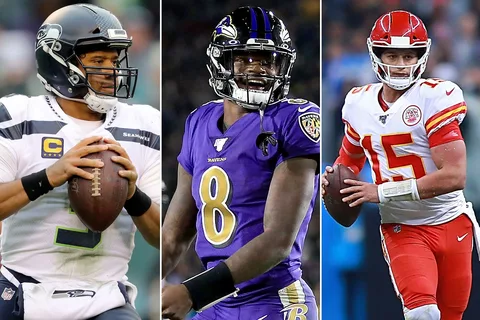
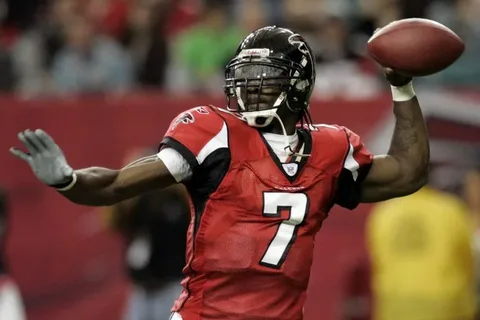
The modern chapter starts with a draft night. In 2001 the Atlanta Falcons took Michael Vick with the first overall pick, making him the first Black quarterback drafted No. 1 overall – a statement, in the plainest business terms, that a franchise was building everything around a Black quarterback’s talent. Steve McNair would go on to share league MVP honours in 2003 with Tennessee, Donovan McNabb would take Philadelphia to a Super Bowl, and the old arguments were quietly dying in front offices even when they lingered on talk radio.
Russell Wilson became the second Black quarterback to win a Super Bowl, with Seattle in the 2013 season. Patrick Mahomes then did something no Black quarterback had done before – he won the Super Bowl more than once, and became the face of the league itself while doing it. Cam Newton won an MVP. Lamar Jackson won it more than once.
The symbolic finish line, if there is one, came on February 12, 2023. Super Bowl LVII, Kansas City against Philadelphia, Patrick Mahomes against Jalen Hurts – the first Super Bowl in which both starting quarterbacks were Black. Kansas City won 38-35. A hundred years after Pollard took snaps for Hammond, the biggest game in American sport opened with a Black quarterback under centre for both teams, and the most remarkable thing about it, for younger fans, was that it did not feel remarkable at all.
That normality is the real legacy of the five men in the table. Not a trivia answer. Normality.
Why it took so long – and why ‘talent’ is not the answer
Every so often someone suggests the delay was just the game evolving, or the talent pool developing, or some other comfortable explanation. The record does not support the comfortable version. Briscoe was told to play cornerback before he broke a rookie record at quarterback. Moon had to win five championships in another country. Harris was replaced repeatedly while winning. Williams was paid a fraction of his peers’ salaries while taking an expansion team to the playoffs.
The common thread is not ability. It is trust. Quarterback is the one position a franchise hands its identity to, and for most of the twentieth century, most owners and coaches would not hand that identity to a Black player. They said it in the language of ‘leadership’ and ‘reading defences’, they practised it through position switching and stacking, and in the 1930s and 1940s they did not bother with coded language at all – they simply excluded Black players entirely.
Naming that honestly is not a distraction from the football. It is the football history. You cannot understand why the first Black NFL quarterback question has five answers spread over sixty-five years without it.
An honest footnote: progress came late, even at the end
One more date keeps this article honest. The New York Giants were the last of the league’s 32 teams to start a Black quarterback, and they only did it in 2017, when Geno Smith started a game. 2017. Long after Williams, long after Moon’s Hall of Fame speech, one franchise still had not crossed that particular line.
So the fair summary is two things at once. The position has been transformed – Black quarterbacks now win MVPs, sign record contracts, get drafted first overall and start Super Bowls on both sides, which would have been unthinkable in Thrower’s lifetime. And the transformation took far longer than it should have, for reasons the men in this article could have explained to you from personal experience. Both halves belong in the story.
Conclusion: remember all five names
So, who was the first Black NFL quarterback? Fritz Pollard, in 1923 – that is the answer to the question exactly as asked, and any article that skips him to start in the 1950s is missing the beginning of its own story. But Pollard alone is not the whole answer either. Thrower reopened a door that had been nailed shut for thirty years. Briscoe started. Harris led a team for a season and won in January. Williams won the Super Bowl and took the MVP trophy home, and Moon’s bust in Canton finished the set.
Next time the question comes up in a bar, a classroom or a trivia night, do not just give one name. Give the timeline. It takes thirty seconds longer, and it is the difference between a trivia answer and a piece of history those five men actually earned.
Frequently Asked Questions
Who was the first Black NFL quarterback?
Fritz Pollard. He played quarterback for the Hammond Pros in 1923, three years after becoming one of the NFL’s first two Black players with the Akron Pros in 1920. He was also the league’s first Black head coach, in 1921.
Who was the first Black quarterback in the modern NFL?
Willie Thrower of the Chicago Bears. On October 18, 1953, he replaced George Blanda against the San Francisco 49ers and completed 3 of 8 passes for 27 yards – the first appearance by a Black quarterback in the modern, post-war NFL.
Who was the first Black quarterback to start an NFL game?
In the modern era, Marlin Briscoe. He started for the Denver Broncos of the AFL on October 6, 1968, in a 10-7 win over Cincinnati, after being drafted as a cornerback and insisting on a tryout at quarterback.
Who was the first Black quarterback to start a season opener?
James ‘Shack’ Harris of the Buffalo Bills, on September 14, 1969. He later became, with the Los Angeles Rams in 1974, the first Black quarterback to start and win an NFL playoff game and to be named Pro Bowl MVP.
Who was the first Black quarterback to win a Super Bowl?
Doug Williams. On January 31, 1988, he started Super Bowl XXII for Washington, threw for 340 yards and four touchdowns – all four in one quarter – in a 42-10 win over Denver, and was named Super Bowl MVP.
Who was the first Black quarterback drafted in the first round?
Doug Williams again. Tampa Bay selected him 17th overall in the 1978 NFL Draft after his record-setting career at Grambling State under coach Eddie Robinson.
Who was the first Black quarterback in the Hall of Fame?
Warren Moon, inducted into the Pro Football Hall of Fame in 2006. Before his NFL career he won five Grey Cups in Canada, and he is the only player in both the Pro Football Hall of Fame and the Canadian Football Hall of Fame.
Why are there so many different answers to this question?
Because ‘first’ can mean different things, and the league’s history has a gap in it. Pollard was first to play the position (1923), Thrower first in the modern era (1953), Briscoe first modern starter (1968), Harris first season-opener and playoff winner, and Williams first Super Bowl winner (1988). A ban on Black players from 1934 to 1946 also split the story in two.
When did two Black quarterbacks first start against each other in a Super Bowl?
Super Bowl LVII on February 12, 2023 – Patrick Mahomes of Kansas City against Jalen Hurts of Philadelphia. Kansas City won 38-35. It came exactly one hundred years after Pollard first played quarterback in the NFL.
Who was the first Black quarterback drafted No. 1 overall?
Michael Vick, taken first overall by the Atlanta Falcons in the 2001 NFL Draft – the first time a franchise used the very first pick in the draft on a Black quarterback.










Leave a Reply