
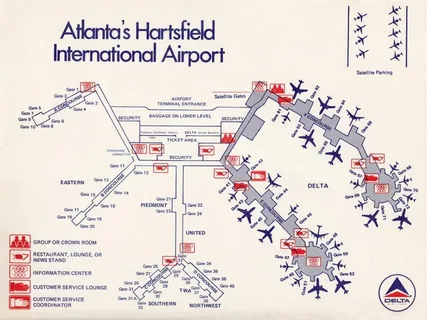
If you have just searched for a Hartsfield Jackson Atlanta map, there is a good chance you are in one of three situations. You are flying out of Atlanta for the first time and the airport looks enormous on paper. You are connecting through Atlanta and your layover feels a little too short for comfort. Or you are picking someone up, dropping someone off, or parking a car, and you simply want to know which side of this giant airport you are supposed to drive to.
All three worries are fair. Hartsfield-Jackson Atlanta International Airport, known to almost everyone by its code, ATL, has for years ranked among the busiest airports in the world. It handles a huge number of flights every single day, it is the main hub of Delta Air Lines, and on a busy morning the main terminal can feel less like a building and more like a small, well-organised city that happens to have runways attached to it.
Here is the reassuring part, and it is the one idea this whole guide is built around: the map of this airport is much simpler than its size suggests. ATL is not a maze of random terminals scattered around a field, the way some large airports are. It is basically one long, straight line. Two terminal buildings sit at opposite ends of that line, seven concourses sit in a neat row between them, and one underground train — the famous Plane Train — runs underneath the whole thing, stopping at every concourse in order. Once that picture clicks in your head, the Hartsfield Jackson Atlanta map stops being intimidating and starts being something you can actually use, even in a hurry, even with a tight connection, even on your very first visit.
This guide walks through that map the way a frequent flyer would explain it to a friend. We will cover the Domestic Terminal and its North and South sides, the International Terminal at the far end, every concourse from T to F and what each one is known for, how gate numbers work, how the Plane Train and the walking tunnels compare, where security and baggage claim fit into the picture, and how to get out of the airport afterwards — by MARTA train, rental car, rideshare, taxi or your own parked car. Along the way you will find honest, practical tips for tight connections, travelling with children, and the handful of mistakes that catch first-time visitors out again and again.
One small note before we start. Airlines occasionally move check-in counters and gates, restaurants open and close, and construction never truly sleeps at an airport this size. Treat this guide as your map and your strategy — and always confirm your exact gate on your boarding pass and on the departure screens on the day you fly. Gates can and do change, sometimes at the last minute.
ATL at a Glance: The Quick Facts
Before the detail, here is the whole airport on one small table. If you remember nothing else from this article, remember this — because almost every question people ask about the Hartsfield Jackson Atlanta map is really a question about one of these rows.
| Item | What You Need to Know |
| Airport name and code | Hartsfield-Jackson Atlanta International Airport — code ATL |
| Terminals | 2 — the Domestic Terminal (west end) and the Maynard H. Jackson Jr. International Terminal (east end) |
| Concourses | 7, in a straight row — T, A, B, C, D, E and F |
| Domestic Terminal sides | South (mainly Delta check-in) and North (mainly other airlines) — always confirm on your booking |
| Getting between concourses | The Plane Train (underground people mover) or the walking tunnels in the Transportation Mall |
| First concourse | Concourse T, attached directly to the Domestic Terminal |
| Last concourse | Concourse F, attached directly to the International Terminal |
| Train to the city | MARTA station inside the Domestic Terminal |
| Rental cars | Rental Car Center, reached by the free SkyTrain from the Domestic Terminal |
| Best rule of thumb | Read the letter in your gate number — that letter is your concourse, and everything else follows from it |
Notice what is missing from that table: there is no Terminal 1, Terminal 2 or Terminal 3. People search for those numbers all the time, because so many other airports use them, but Atlanta simply does not work that way. At ATL you think in two steps. First, which terminal do you start from — Domestic or International? Second, which concourse letter is on your boarding pass — T, A, B, C, D, E or F? Answer those two questions and you already understand most of the map.
How the Layout Actually Works: One Straight Line
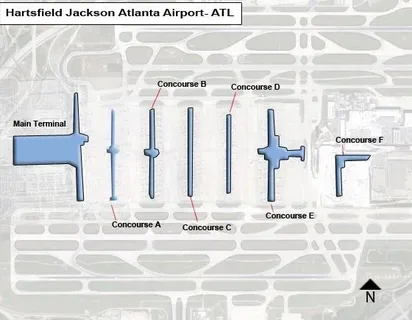
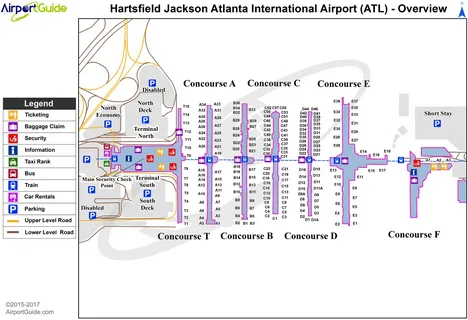
Picture the airport from above, the way it appears on the official Hartsfield Jackson Atlanta map. On the far left, the western end, sits the Domestic Terminal — the big, busy front door used for most flights within the United States. On the far right, the eastern end, sits the International Terminal. Stretched out in a row between those two buildings, running parallel to each other like the rungs of a ladder, are the seven concourses: T first, then A, then B, then C, then D, then E, and finally F, which connects straight into the International Terminal.
Underneath all of it, below ground, runs the spine of the airport — a long underground level often called the Transportation Mall. This is where the Plane Train lives, and alongside the train tracks there is a pedestrian walkway, so you always have two ways to move along the line: ride, or walk. Every concourse has escalators and elevators at its centre that drop you down to that underground level, and every concourse also connects upward to its own gates, shops and restaurants. The pattern repeats identically seven times, which is exactly why the airport becomes easy once you have done it once. Down to the train, along to your letter, up to your gates. Down, along, up. That is the whole system.
This design has one more advantage that matters a lot to connecting passengers: everything is connected inside security. Once you have cleared security at either terminal, you can reach every single concourse and every single gate without going outside, without catching a bus across the airfield, and — for a normal domestic connection — without clearing security again. The two terminals may have separate front doors on the road side, but behind security they are one connected airport. That single fact is what makes short connections in Atlanta realistic at all.
The Domestic Terminal: North Side, South Side, One Building
Most travellers start their journey at the Domestic Terminal, so it deserves a careful look. From the road it presents itself as one very large terminal building, but inside it is organised into two sides — the South Terminal and the North Terminal — joined by a big central atrium. The split is mainly about check-in. As a general rule that has held for years, the South side is where Delta Air Lines handles its check-in and bag drop, which makes sense when you remember that Atlanta is Delta’s home and its biggest hub by a wide margin. The North side is where most of the other airlines operating domestic flights handle their check-in — carriers such as American, United, Southwest, JetBlue, Spirit, Frontier and Alaska, among others.
Treat that split as a strong guideline rather than an unbreakable law. Airlines adjust counters over time, and your booking confirmation and boarding pass always outrank any guide, including this one. If you are being dropped off, tell your driver the airline first and the side second, because the roadways, doors and parking decks are organised around that North–South split, and being dropped on the wrong side means a longer walk with your bags before you even reach a check-in desk.
Inside, the Domestic Terminal holds the things you would expect at the start of a journey: check-in counters and self-service kiosks, bag drop, the main security checkpoints, and — on the arrivals level — baggage claim for domestic flights, plus the doors out to passenger pick-up, taxis, hotel shuttles and parking. Rising above the middle of it all is the atrium, a tall central space with seating, food and shops that many travellers use as their meeting point and their last calm moment before security. If you are meeting someone inside the terminal, ‘the atrium, under the big central area’ is the landmark locals actually use.
Directly behind the Domestic Terminal, connected to it, sits Concourse T — the first of the seven concourses and the only one you can simply walk into from the terminal after security without using the train at all. That detail matters more than it sounds, and we will come back to it in the concourse guide below.
The International Terminal: The Airport’s Other Front Door
At the opposite, eastern end of the map sits the Maynard H. Jackson Jr. International Terminal, usually shortened to the International Terminal. It opened to serve Atlanta’s growing long-haul traffic, and it works as a complete terminal in its own right: its own check-in hall, its own security checkpoint, its own baggage claim for international arrivals, its own roadways and its own parking. It connects directly to Concourse F, the last concourse in the row, in exactly the same way the Domestic Terminal connects directly to Concourse T.
The single most important thing to understand about the International Terminal is that it is not reached by driving to the Domestic Terminal and continuing around. It has its own separate road access and its own signs, and the two terminals sit a considerable distance apart with runways and concourses between them. If your flight departs from the International Terminal, or you are collecting someone arriving on an international flight, follow the road signs for ‘International Terminal’ or ‘Maynard H. Jackson Jr. Terminal’ from the start, and allow the extra driving time. Turning up at the Domestic Terminal for an international departure is one of the most common — and most stressful — mistakes on the whole Hartsfield Jackson Atlanta map, because fixing it eats time you may not have.
Which terminal should you actually use? Your airline and your ticket decide that, not you. Many international departures check in at the International Terminal, but some international flights are handled from the Domestic Terminal side, and some domestic flights use gates on Concourses E or F. So read your booking, follow your airline’s instructions, and check the terminal listed there. Behind security, remember, it all connects anyway: a passenger who checks in at the International Terminal can ride the Plane Train to a gate on Concourse A, and a passenger who checks in at the Domestic Terminal can ride it all the way to Concourse F. The front door matters for check-in, bag drop and pick-up. It does not trap you on one side of the airport.
Concourse by Concourse: T, A, B, C, D, E and F
Now for the part of the map where you actually board your flight. Each concourse is a long building with gates on both sides, shops and restaurants mainly near its centre, and the escalators down to the Plane Train at that centre point. Gate numbers grow as you walk away from the centre in either direction, so a low gate number usually means a short walk from the train, while a high gate number can mean a genuinely long stroll down the concourse. Keep that in mind when you glance at the clock.
| Concourse | Position on the Map | What It Is Known For |
| T | West end, attached to the Domestic Terminal | The walk-in concourse — no train needed from Domestic security; a mix of airlines and some Delta flights |
| A | Second in the row | Busy mainly-Delta concourse; first full stop on the Plane Train |
| B | Middle-west | Another core Delta concourse; often the busiest train stop for connections |
| C | Centre of the airport | Mixed airlines including Delta flights; the midpoint of the whole line |
| D | Middle-east | Mixed airlines; a narrower, busy concourse with a wide mix of carriers |
| E | Second from the east end | Many international departures and arrivals, plus some domestic flights |
| F | East end, attached to the International Terminal | International flights, customs and immigration for many arrivals, direct link to the International Terminal |
Concourse T — The One You Can Walk To
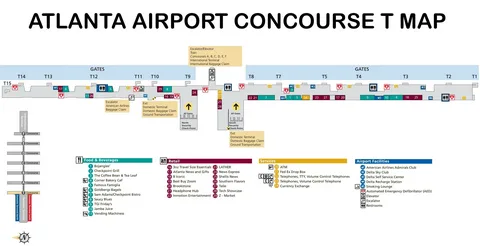
Concourse T earns its letter honestly: T for Terminal. Because it is attached to the Domestic Terminal, passengers heading to a T gate simply clear security and walk straight in. It hosts a mix of airlines along with some Delta services, and its gates are among the easiest in the airport to reach — but do not let that make you casual. The concourse is long, and a high-numbered T gate is still a proper walk from the checkpoint.
Concourses A and B — The Heart of the Delta Hub
If Atlanta is Delta’s hub, Concourses A and B are where that hub beats loudest. A large share of Delta’s domestic operation runs through these two concourses, which is why so many connecting itineraries read like alphabet soup — arriving at B, departing from A, with the Plane Train in between. Both are well supplied with restaurants, coffee, shops and airline service desks, and both get very busy at the peak connection banks in the morning and late afternoon. If your connection runs through A or B, you are in the most practised part of the airport: staff here handle tight connections all day, every day.
Concourse C — The Middle of Everything
Concourse C sits at the centre of the line, which makes it the natural midpoint of any cross-airport journey. It serves a mix of airlines, including Delta flights and other carriers, and because of its central position it is rarely the ‘wrong’ place to be — every other concourse is at most a few train stops away. Travellers with a long layover sometimes aim for the centre concourses deliberately, simply because the choice of food and seating is wide and nothing is far away.
Concourse D — Busy and Mixed
Concourse D continues the mixed pattern, hosting a variety of airlines and a steady flow of domestic services. Regulars will tell you it can feel tighter and busier than its neighbours, especially at peak times, so if your flight leaves from D, it is worth arriving at the gate area a little earlier rather than cutting across the airport at the last moment.
Concourses E and F — The International End
Concourses E and F, at the eastern end of the line, handle much of Atlanta’s international flying. Concourse E has long been associated with international departures and arrivals, and Concourse F — attached to the International Terminal — is where many international passengers check in, clear security and, on arrival, pass through customs and border control. You will notice a different mix of shops here, more long-haul aircraft at the gates, and more passengers settling in for genuinely long flights. Both concourses also see some domestic services, so never assume your flight type purely from the letter — check the gate, not the guess.
How Gate Numbers Work — And Why the Letter Matters Most
Every gate at ATL is named with one letter and one number, like A12, B32 or F4. The letter is the concourse. The number is the position along that concourse. That is genuinely all there is to it, and yet understanding it properly saves real time. When your boarding pass says B32, your job is not ‘find gate 32 somewhere in this enormous airport’. Your job is much smaller: get yourself to Concourse B, then follow the signs along that one building to gate 32. Seven separate searches collapse into one simple trip.
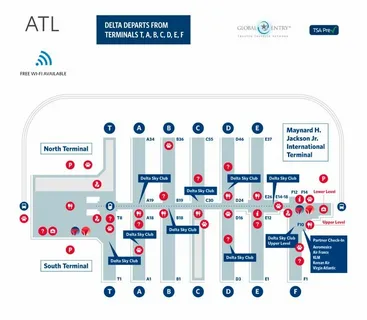
Two refinements are worth knowing. First, as mentioned above, gates are arranged outwards from the centre of each concourse, where the Plane Train escalators arrive. Low numbers sit near the centre; high numbers sit far down the ends. So B4 is a short hop from the train, while a gate in the thirties or beyond can add several minutes of walking — with moving walkways helping on some stretches, but never as fast as people optimistically assume. Second, the letter always beats the number for planning your time. Moving from gate A10 to gate A28 is a walk. Moving from A10 to E10 is a train ride across most of the airport, even though the number stayed the same. When you judge a connection, compare the letters first, then the numbers.
The Plane Train: The Underground Train That Holds the Map Together
The Plane Train is the airport’s underground automated people mover, and it is the single most useful thing on the Hartsfield Jackson Atlanta map. It runs in a loop beneath the concourses, stopping in order at Concourse T, then A, B, C, D, E and F, and continuing to the baggage claim and terminal station at the Domestic end. Trains come frequently — typically every couple of minutes or so — the ride between neighbouring concourses takes roughly a minute, and the full run from one end of the line to the other takes only a matter of minutes. For an airport of this size, that is a small miracle of design, and it is the main reason connections that would be impossible elsewhere are merely brisk in Atlanta.
Using it is deliberately simple. From any concourse, follow the signs for the Plane Train or ‘Connecting Flights’ to the centre of the concourse, take the escalator or elevator down one level, and board the next train heading in your direction — the station signs and the announcements make the direction clear, and regular riders will happily confirm it if you ask. Hold on when it starts moving; the train accelerates with real enthusiasm and catches first-timers off balance every day. Listen to the announcements, which name each concourse as you arrive, and ride the escalator at the other end straight up into your concourse, where the gate signs take over.
A few honest warnings from experience. At peak connection times the train platforms, especially at the busy middle concourses, can be crowded, and a train can occasionally arrive already full — the next one is close behind, so do not panic and do not force your way in. Very occasionally the train is paused for maintenance or a technical issue; when that happens, the walking tunnels described next stop being a backup plan and become the plan, and airport staff will direct you. And if your gate is on Concourse T and you are coming from the Domestic Terminal, skip the train completely — you are already there.
Walking Between Concourses: The Tunnels Most People Miss
Running alongside the Plane Train, on the same underground level, is a pedestrian walkway connecting all the concourses, complete in stretches with moving sidewalks, and decorated along its length with art installations that have become minor landmarks in their own right — the walk between the central concourses, in particular, is famous among frequent flyers for its colourful, light-filled display. Walking is a genuinely good option in the right situation. Between neighbouring concourses, say B to C, a brisk walker can rival the train door-to-door once you count waiting and riding time, and you are in control of your own pace the entire way.
The honest rule is distance. One concourse apart? Walking is pleasant and reliable. Two apart? Walking is fine if you have time and enjoy stretching your legs after a flight. Three or more apart, with a connection clock ticking? Take the train, every time. The underground distances are longer than they feel on a flat map, and the passengers who misjudge Atlanta are almost always the ones who decided to stroll a journey the train was built for. Whichever you choose, the route is the same simple pattern: down at the centre of your concourse, along the underground level, and up at the centre of your destination concourse.
Security Checkpoints: Where They Are and How to Choose
Security at ATL is organised around the two terminals. The Domestic Terminal has the airport’s main checkpoints, including the principal checkpoint feeding into the concourse system, and the International Terminal has its own checkpoint for passengers starting there. After any of them, remember, you are inside the one connected airside world — your checkpoint choice affects your start, not which gates you can reach. Standard guidance applies with extra force here: this is a very busy airport, so arrive with a proper margin — the commonly suggested two hours before a domestic departure and three hours before an international one is sensible advice at ATL, not cautious overkill, particularly at morning and holiday peaks.
If you are enrolled in an expedited screening programme, look for the dedicated lanes signed at the checkpoints, and if you are travelling at a peak time, it is worth glancing at more than one checkpoint option where the terminal layout offers one, because queues can differ noticeably between checkpoints that ultimately lead to the same concourses. Once through, do the small thing experienced travellers always do: stop, check the departure screen for your gate — confirm it has not changed — and only then start moving. Thirty seconds at the screen has saved more connections than any sprint ever has.
Arriving at ATL: Baggage Claim and Finding Your Way Out
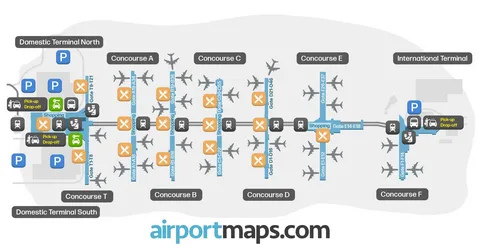
Arriving is where the map runs in reverse, and the same logic still works. When your flight lands, follow the signs for baggage claim and ground transportation, which will lead you down to the Plane Train if you have landed at any concourse beyond T, and ride it towards the terminal end. Domestic arrivals collect their bags at the Domestic Terminal’s baggage claim, which is organised into North and South areas that broadly follow the airline split described earlier — your flight’s screens and the airport announcements will point you to the right carousel area, so follow your airline, not your instinct. International arrivals are handled at the International Terminal side, where passengers pass through passport control and customs before reaching the arrivals hall — the process is covered in more detail in the international section below.
Do not underestimate the length of this final journey. From a far gate on Concourse F to a suitcase at the Domestic Terminal is a real sequence — walk to the concourse centre, ride the train almost the full line, then find your carousel — and it can comfortably take longer than visitors expect. If someone is collecting you, the kindest thing you can do is tell them honestly that ‘landed’ and ‘standing outside with bags’ are two very different moments at ATL, separated by a train ride and a baggage hall.
Getting Out of the Airport: MARTA, SkyTrain, Rental Cars, Rideshare and Parking
The Hartsfield Jackson Atlanta map does not end at the terminal doors, because for many travellers the most confusing part of the journey is the last mile. The good news is that ATL is unusually well connected — if you know which option lives where.
MARTA — The Train Into Atlanta
The airport’s MARTA station sits right at the Domestic Terminal, a short walk from domestic baggage claim, and its trains run into the city, connecting through downtown and onward to the wider rail network. For a solo traveller heading downtown or to areas along the rail lines, it is usually the simplest and most predictable option of all: no traffic, no surge pricing, no circling car parks. If you arrived on an international flight at the International Terminal, you can ride the Plane Train across the airport to the Domestic side to reach the station, or use the airport’s connecting shuttle between the terminals — just build that transfer into your timing.
The SkyTrain and the Rental Car Center
Rental cars at ATL are centralised in a dedicated Rental Car Center away from the terminal, reached by a different train from the Plane Train: the SkyTrain, a free automated train that runs from the Domestic Terminal area to the Rental Car Center, also serving the airport’s convention and hotel district on the way. The distinction trips people up, so say it plainly — Plane Train: between concourses, inside the airport. SkyTrain: out to the rental cars. If you are collecting a car, follow the ‘Rental Cars’ signs from the Domestic Terminal, ride the SkyTrain, and you will arrive at a single building where the rental companies are gathered together.
Rideshare, Taxis and Pick-Up
Taxis, limousines and app-based rideshare pick-ups each have their own designated areas, and at an airport this size ‘designated’ really means it: your driver will be directed to a specific pick-up zone, and your app will tell you which one and how to reach it. Follow the signs for your chosen option from baggage claim rather than simply walking out of the nearest door and hoping. If a friend is collecting you, agree the terminal — Domestic North, Domestic South, or International — before they set off, because those are effectively three different destinations on the road map even though they share one airport name.
Parking
Parking at ATL is spread across garages and lots serving both terminals, including hourly parking close to the terminals for pick-ups and short stays, daily parking for trips, and economy options further out with shuttle connections. The practical advice is simple: decide your terminal first — Domestic or International — then choose the parking signed for that terminal, and book or check availability in advance on a peak travel day. Parking at the wrong terminal is not a disaster, thanks to the shuttle and the trains, but it is an avoidable twenty minutes at each end of your trip.
Making a Connection at ATL, Step by Step
Connecting passengers are the people who search for the Hartsfield Jackson Atlanta map with the most urgency, so here is the whole process, played slowly. Step one: as your flight lands, check your onward gate in your airline’s app or on your boarding pass — letter first. Step two: leave the aircraft and walk to the centre of the arrival concourse, following ‘Connecting Flights’ and Plane Train signs. Step three: if your departure concourse is the one you are already on, walk the concourse to your new gate and relax. Step four: if it is one concourse away, choose the train or a brisk tunnel walk. Step five: if it is further, take the Plane Train, ride it to your letter, go up, and walk to your gate. Step six: on arrival at the gate, look at the screen, confirm your flight, and only then go in search of coffee.
How much time does this really take? A smooth same-concourse change can be five minutes of walking. A typical cross-airport change — say, Concourse B to Concourse E — is often around fifteen to twenty minutes of unhurried movement once you include the walk to the train, a short wait, the ride and the walk to the gate. Where connections get tight is not the train; it is a late-arriving first flight, a gate at the far end of a concourse, or a pause for food at exactly the wrong moment. The habits that protect you are boring and effective: know your onward gate before you land, walk with purpose until you reach it, and do your eating and shopping after you have seen your departure gate with your own eyes.
If the worst happens and a delay makes your connection impossible, go straight to your airline’s service desk or app rather than running hopefully to a gate. Atlanta’s staff handle rebookings on a huge scale every day, and the earlier you are in that system, the better your options usually are.
International Arrivals: Customs, Bags and Connecting Onwards
Arriving into the United States at ATL follows the standard pattern, but the map shapes how it feels. International flights arrive mainly at Concourses E and F. You will follow the signs to passport control, then collect any checked bags, pass through customs, and then make one key decision at the exit: are you finished travelling, or connecting onwards? Follow the ‘Connecting Flights’ signs if you are connecting — there is a dedicated route that returns connecting passengers into the airside system, with bags rechecked along the way where your itinerary requires it. Follow the arrivals and exits signs if Atlanta is your final destination, which leads you out through the International Terminal’s arrivals hall to ground transportation, pick-up and parking.
The mistake to avoid is drifting. At the customs exit the two flows separate, and a connecting passenger who accidentally exits fully into the public arrivals area faces a much longer recovery — back through the terminal, and through security again — than one who simply follows the connecting signs in front of them. Pause for ten seconds at that junction, read the signs, and choose deliberately. It is the highest-value pause in the whole airport.
Food, Coffee, Shops and Lounges: Where to Spend a Layover
Nobody goes hungry at ATL. Every concourse has its own spread of restaurants, fast food, coffee shops and news-and-snacks stores, with the widest choice usually clustered near the centre of each concourse, where the Plane Train escalators arrive. Atlanta takes a little pride in its airport food, and alongside the familiar national names you will find local Atlanta restaurants represented in the concourses — a genuinely nice touch on a long layover, when a meal can be the difference between enduring an airport and almost enjoying it. The Domestic Terminal’s atrium, before security, also has food and seating that works well for meeting people or waiting for a travelling companion to arrive.
Airline lounges follow the hub pattern: Delta Sky Clubs are spread across multiple concourses, reflecting the scale of Delta’s operation here, and other lounge options exist for eligible passengers on other carriers and programmes. Lounge locations and access rules change, so check your airline’s app for the lounge nearest your gate rather than memorising a list. The strategic point for a layover is simple: settle near your departure concourse, not near whichever restaurant you spotted first. A wonderful meal on Concourse A is a poor trade for a panicked train ride to Concourse F at final call.
Accessibility and Travelling With Family
An airport laid out as one straight line with a train running beneath it is, by airport standards, a friendly design for travellers who need step-free routes. Elevators at every concourse centre connect the gate level with the Plane Train level, the train itself is level-boarding, and wheelchair assistance can be arranged through your airline — ideally booked in advance, and requested again at check-in if anything about your journey has changed. Travellers who find long concourses difficult should remember the gate-number rule: high numbers mean long walks, and asking the airline for assistance is a normal, everyday request at ATL, not a special favour.
Families get the same geography lesson in a friendlier form. The train ride is, for most children, the highlight of the airport — budget it as entertainment, not transport. The underground walking tunnels, with their art and light displays, are a good way to burn energy on a long layover without going anywhere near a departure board panic. And the practical parent rules apply doubly here: bathrooms and water before boarding the train to a far concourse, snacks bought before the final gate dash, and a meeting point agreed — ‘at the top of the escalators, by the big signs’ — in case anyone gets separated in a crowd.
The Official Map, Airline Apps and Third-Party Maps: Which to Trust
You will find the Hartsfield Jackson Atlanta map in several places, and they are not all equal. The airport’s own official map — available on the airport’s website and in printed and interactive forms around the terminals — is the reference version for terminal layouts, checkpoint locations, parking and ground transport, and it is the one to trust for anything structural. Your airline’s app is the best source for the thing that changes most: your live gate, your departure time and any rebooking. Third-party map sites and blog guides like this one are useful for understanding and strategy — how the airport thinks, where the traps are, how long things take — but they cannot know that your gate changed six minutes ago.
Used together, the three layers work beautifully. Learn the shape of the airport from a guide before you travel. Check the official map when you are deciding about terminals, parking or pick-up points. And on the day itself, let your airline’s app and the airport’s own departure screens have the final word on gates and times. That division of trust is exactly how frequent flyers do it, whether or not they have ever thought about it in those terms.
Seven Mistakes First-Time Visitors Make at ATL
First, driving to the wrong terminal — going to Domestic for an International Terminal departure, or the wrong side of Domestic for a pick-up. Decide the terminal before you leave home. Second, confusing the Plane Train with the SkyTrain, and discovering at the rental car end of a concourse train ride that concourses were never the destination. Third, treating all gates as equal: a high-numbered gate at the far end of a concourse is a long walk, and the map’s scale hides it. Fourth, strolling a long connection in the tunnels when the train exists for exactly that journey. Fifth, exiting fully into the arrivals hall after an international flight when you were supposed to follow the Connecting Flights route. Sixth, assuming Terminal 1, 2 and 3 exist and hunting for signs that will never appear — Atlanta speaks in Domestic, International, and letters. Seventh, and most common of all, not checking the gate again after landing or after security. Gates change. The screen is right and your memory of this morning’s boarding pass may not be.
Final Word: Big Airport, Simple Map
Hartsfield-Jackson earns its reputation honestly. It is vast, it is busy, and at peak times it moves more people than some cities hold. But reputations about its difficulty are largely undeserved, because underneath the scale sits one of the clearest layouts in aviation: two terminals, seven concourses in a row, one train underneath, and a gate code that tells you exactly where you are going in two characters. Learn the line, trust the letter, ride the train without overthinking it, and check the screens as you go. Do that, and the Hartsfield Jackson Atlanta map stops being something you need to search for — and becomes something you simply know.
Frequently Asked Questions
Where can I find the official Hartsfield Jackson Atlanta map?
On the airport’s official website, which offers terminal and concourse maps, and on information screens and printed maps inside the terminals. Use the official map for terminals, parking and checkpoints, and your airline’s app for your live gate.
How many terminals and concourses does Atlanta airport have?
Two terminals — the Domestic Terminal and the Maynard H. Jackson Jr. International Terminal — and seven concourses in a row: T, A, B, C, D, E and F. There are no numbered terminals like Terminal 1 or 2.
What is the difference between the Domestic Terminal’s North and South sides?
They are two sides of one building, split mainly by check-in. The South side is mainly Delta Air Lines; the North side is mainly other airlines. Always confirm your side from your booking, as assignments can change.
How do I get between concourses at ATL?
Ride the Plane Train, the underground train that stops at every concourse in order, or walk the underground pedestrian tunnels in the Transportation Mall. Neighbouring concourses are an easy walk; longer hops are much faster by train.
What is the difference between the Plane Train and the SkyTrain?
The Plane Train runs inside the airport, between the concourses. The SkyTrain runs outside the secure area, from the Domestic Terminal to the Rental Car Center. Different trains, different jobs — follow the signs for the one you actually need.
Which concourse does Delta use at Atlanta?
Delta, whose biggest hub is Atlanta, operates across several concourses, with a heavy presence in Concourses T, A, B and C and flights from other concourses too, including international services from E and F. Check your boarding pass for your exact gate.
How long does a connection at ATL take?
A same-concourse change can take about five minutes of walking. A typical cross-airport change using the Plane Train is often around fifteen to twenty minutes. The bigger risks are a late inbound flight and a far-end gate, not the train itself.
How do I get from ATL into the city?
The MARTA station inside the Domestic Terminal runs trains into downtown Atlanta and connects to the wider rail network. Taxis, rideshare pick-up zones, hotel shuttles and the SkyTrain to the Rental Car Center cover the other main options.
Where do I go for an international departure or arrival?
Most international travel uses the International Terminal and Concourses E and F. The International Terminal has its own road access and parking, separate from the Domestic Terminal — follow its signs from the start, and confirm your terminal on your booking.
Is Atlanta airport hard to navigate for a first-time visitor?
Honestly, no — once you understand that it is one straight line. Two terminals at each end, concourses T to F in a row, one train underneath, and a gate letter that tells you your destination. Check the departure screens as you go and it quickly feels routine.













Leave a Reply