

The Blue Raider Adventure Park general ledger is a useful topic for students learning the fundamentals of financial accounting. It brings together several important concepts, including journal entries, debits and credits, account balances, trial balances, and the accounting cycle. Understanding these concepts helps students see how individual business transactions become organized financial information.
The Blue Raider Adventure Park scenario is associated with accounting coursework for ACTG 2110, Principles of Accounting I, at Middle Tennessee State University. It is best understood as an educational business scenario rather than a verified operating adventure park. The exact transactions and amounts depend on the original assignment provided by the instructor. ACTG 2110 Guide+1
This article explains how a general ledger works, how journal entries are posted, how account balances are calculated, and how students can check their accounting work. All dollar amounts used in the examples are illustrative, not official Blue Raider Adventure Park assignment figures.
What Is the Blue Raider Adventure Park General Ledger?
A general ledger is a central accounting record that organizes financial transactions by account. Instead of keeping every transaction in a single chronological list, the ledger separates activity into individual accounts, such as Cash, Equipment, Accounts Payable, Service Revenue, and Operating Expenses.
Each account shows how transactions affect its balance over an accounting period.
For example, imagine an adventure park business that receives money from customers, purchases equipment, pays employees, and buys supplies. Every event that affects the business financially must be recorded in the accounting system.
The general journal records these transactions in chronological order. The general ledger then groups the relevant amounts under the accounts affected by each transaction.
This organization makes it easier to determine how much cash the business has, what it owes to suppliers, how much revenue it has earned, and what expenses it has incurred.
In the Blue Raider Adventure Park accounting exercise, the general ledger serves as an important step between recording transactions and preparing a trial balance.
A typical ledger account may include:
- Account name and account number
- Transaction date
- Journal reference
- Debit amount
- Credit amount
- Running balance
The precise format depends on the accounting worksheet or software being used. Some assignments use traditional T-accounts, while others provide a table with separate debit and credit columns.
Regardless of the format, the purpose remains the same: to maintain an organized record of each account’s financial activity.
Why Is the General Ledger Important?
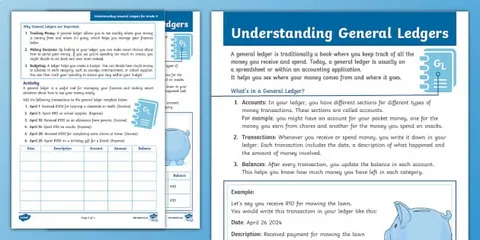
The general ledger is important because it brings individual transactions together into a structured financial record.
Without a ledger, a business might have receipts, invoices, payment records, and journal entries but no convenient way to determine the current balance of each account.
A properly maintained ledger helps answer practical questions.
How much money is available in the Cash account? How much remains payable to suppliers? What equipment has been recorded? How much revenue has been earned during the period? Which expenses have accumulated?
These questions matter to both business owners and accounting students.
The ledger also helps identify errors. If an account balance appears unusual, the accountant can trace the balance back to the individual postings and the original journal entries.
Another important benefit is that the ledger provides the account balances needed to prepare a trial balance and financial statements.
For students, learning to prepare a general ledger develops a habit of following transactions through the complete accounting process rather than treating each journal entry as an isolated exercise.
Understanding the Accounting Equation
Before preparing a general ledger, it is helpful to understand the basic accounting equation:
Assets = Liabilities + Equity
Assets are resources controlled by a business. Examples include cash, equipment, supplies, and accounts receivable.
Liabilities are obligations the business owes to other parties. Examples include accounts payable and certain loans.
Equity represents the owner’s or shareholders’ interest in the business, depending on its legal structure.
The equation must remain balanced as transactions are recorded.
Suppose a business owner invests $10,000 in a new adventure park operation. The business receives cash, increasing its assets, while the owner’s equity increases by the same amount.
The transaction can be recorded as follows.
| Account | Debit | Credit |
|---|---|---|
| Cash | $10,000 | — |
| Owner’s Capital | — | $10,000 |
| Total | $10,000 | $10,000 |
This is a hypothetical example showing the accounting principle. It is not a transaction taken from the official Blue Raider Adventure Park assignment.
The equation remains balanced because assets increase by $10,000 and equity increases by $10,000.
Understanding this relationship makes it easier to identify the accounts affected by a transaction before deciding which side should be debited or credited.
General Journal vs. General Ledger
The general journal and general ledger work together, but they have different purposes.
The journal records transactions in chronological order. The ledger organizes those transactions by account.
For example, a business might record equipment purchases, customer payments, utility bills, and employee wages in the same journal. In the ledger, each transaction is posted to the appropriate account.
| Feature | General Journal | General Ledger |
|---|---|---|
| Main purpose | Records transactions by date | Organizes transactions by account |
| Organization | Chronological | Account-based |
| Primary information | Transaction details and entries | Account activity and balances |
| Common format | Journal entry table | Individual accounts or T-accounts |
| Role in accounting | Records transactions initially | Summarizes account activity |
| Next major step | Posting to ledger | Preparing the trial balance |
Neither record replaces the other.
A journal entry can be correct but still produce an incorrect ledger if the amounts are posted to the wrong accounts. Likewise, a ledger may appear organized while containing an error inherited from the original journal entry.
Students should therefore compare both records when checking their work.
How Debits and Credits Work
Debits and credits are the foundation of double-entry bookkeeping.
A debit is recorded on the left side of an account, while a credit is recorded on the right side. Whether a debit or credit increases an account depends on the account type.
| Account type | Increase | Decrease |
|---|---|---|
| Assets | Debit | Credit |
| Expenses | Debit | Credit |
| Liabilities | Credit | Debit |
| Equity | Credit | Debit |
| Revenue | Credit | Debit |
These rules are especially important when working through a multi-step accounting assignment.
For example, purchasing equipment with cash increases the Equipment account and decreases the Cash account.
The journal entry would be:
| Account | Debit | Credit |
|---|---|---|
| Equipment | $2,000 | — |
| Cash | — | $2,000 |
| Total | $2,000 | $2,000 |
The Equipment account receives a debit because the asset increases. The Cash account receives a credit because cash decreases.
Notice that the transaction does not necessarily change the business’s total assets. It simply converts part of the cash balance into equipment.
A student who understands this relationship can make better decisions when selecting accounts and preparing ledger entries.
How to Post Journal Entries to the General Ledger

Posting means transferring the amounts recorded in the general journal into the corresponding ledger accounts.
The process should be completed carefully because errors at this stage can affect every later accounting step.
Step 1: Read the Original Transaction
Begin by identifying what happened.
Did the business receive money, purchase equipment, provide a service, pay an expense, or acquire something on credit?
Understanding the event is more important than immediately deciding which account to debit.
Step 2: Identify the Accounts Affected
Every transaction affects at least two accounts under double-entry accounting.
For example, purchasing supplies with cash affects Supplies and Cash.
Providing a service on credit affects Accounts Receivable and Service Revenue.
Paying an outstanding supplier invoice affects Cash and Accounts Payable.
The account names should match the chart of accounts supplied with the assignment.
Step 3: Prepare the Journal Entry
Determine which accounts increase or decrease, then apply the debit and credit rules.
Suppose an adventure park purchases $600 of supplies with cash.
The illustrative journal entry is:
| Account | Debit | Credit |
|---|---|---|
| Supplies | $600 | — |
| Cash | — | $600 |
| Total | $600 | $600 |
The debit and credit totals are equal, satisfying the double-entry requirement.
Step 4: Open the Relevant Ledger Accounts
Locate the Supplies account and Cash account in the general ledger.
If the worksheet uses T-accounts, enter the debit on the left side of Supplies and the credit on the right side of Cash.
If the worksheet uses a running-balance format, record the date, reference, amount, and updated balance.
Step 5: Transfer the Amounts Accurately
Enter the $600 debit into Supplies and the $600 credit into Cash.
Do not change the amount while posting. The ledger should reflect the journal entry exactly.
Step 6: Update the Account Balances
If Supplies previously had a zero balance, the new balance becomes $600, assuming no other activity.
If Cash previously had a debit balance of $5,000, its balance becomes $4,400 after the payment.
Step 7: Check the Posting
Compare the ledger entries with the original journal entry.
Make sure both accounts were updated, the amounts match, and the debit and credit sides have not been reversed.
Following the same procedure for every transaction creates a clear record that can be checked later.
Common Accounts in an Adventure Park General Ledger

An adventure park business scenario can involve several different account categories. The exact accounts required for the Blue Raider Adventure Park assignment should be taken from the original worksheet.
Cash
Cash records money received and paid by the business.
Customer payments, owner investments, and other cash receipts generally increase the Cash account through debits. Cash payments generally reduce it through credits.
Because Cash is frequently affected by transactions, it is especially important to maintain an accurate running balance.
Accounts Receivable
Accounts Receivable represents money customers owe the business.
When a business provides a service on credit, it generally debits Accounts Receivable and credits Service Revenue.
When the customer later pays, the business debits Cash and credits Accounts Receivable.
This second transaction collects an existing receivable. It does not create new revenue if the revenue was already recognized when the service was provided.
Supplies
Supplies may include items purchased for business operations.
When supplies are purchased, the accounting treatment depends on the method specified in the assignment. They may initially be recorded as an asset.
As supplies are consumed, the appropriate amount can be recognized as Supplies Expense through an adjusting entry.
Equipment
Equipment represents qualifying long-term assets used in business operations.
Examples in a hypothetical adventure park might include certain safety equipment, tools, or other operating assets.
Equipment purchases are generally debited to Equipment when they meet the applicable asset-recognition criteria. Depreciation and asset disposals require additional accounting entries.
Accounts Payable
Accounts Payable records amounts owed to suppliers and other creditors.
When supplies or other items are purchased on credit, Accounts Payable generally increases through a credit.
When the business pays the supplier, Accounts Payable decreases through a debit, while Cash decreases through a credit.
Revenue
Revenue represents income earned from providing goods or services.
A business might earn revenue from customer admissions, guided activities, or other services, depending on the scenario.
Revenue normally increases through credits. However, cash received before the related service is provided may need to be recorded as Unearned Revenue rather than immediately recognized as earned revenue.
Expenses
Expenses represent the costs incurred in operating the business.
Examples may include wages, utilities, insurance, maintenance, and supplies consumed.
Expenses generally increase through debits.
Accurate expense classification helps produce meaningful financial statements and allows the business to understand where its money is being spent.
Equity
Equity accounts reflect the owner’s or shareholders’ interest in the business.
The appropriate accounts depend on the legal structure specified in the assignment. A sole proprietorship, for example, may use Owner’s Capital and Owner’s Drawings.
Students should not assume that every business uses the same equity account titles.
Calculating General Ledger Account Balances
Calculating the ending balance is a central part of general ledger preparation.
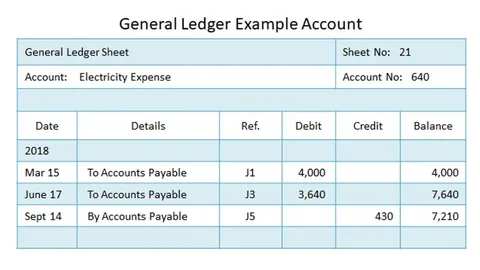
For a typical asset account with a debit balance, the formula is:
Ending balance = Beginning balance + Debits − Credits
Consider the following hypothetical Cash account.
| Cash account activity | Amount |
|---|---|
| Beginning balance | $10,000 |
| Additional cash received | +$3,000 |
| Cash payments | −$2,000 |
| Ending balance | $11,000 |
The business began with $10,000, received another $3,000, and paid out $2,000.
The ending Cash balance is therefore $11,000.
For a liability account with a credit balance, the calculation is reversed:
Ending balance = Beginning credit balance + Credits − Debits
Suppose Accounts Payable begins with $4,000. The business purchases another $1,500 on credit and then pays a supplier $2,000.
| Accounts Payable activity | Amount |
|---|---|
| Beginning balance | $4,000 |
| Additional amount owed | +$1,500 |
| Supplier payment | −$2,000 |
| Ending balance | $3,500 |
The remaining liability is $3,500.
These formulas assume the normal balance remains on its expected side. If an account has an unusual balance, students should examine the underlying transactions rather than automatically applying the usual pattern.
What Is a Trial Balance?
A trial balance is a list of general ledger accounts and their ending balances at a particular point in the accounting process.
The purpose is to check whether the total debit balances equal the total credit balances.
After all required journal entries have been posted, the student transfers the ending balance of each account into the trial balance.
A simplified hypothetical example is shown below.
| Account | Debit | Credit |
|---|---|---|
| Cash | $8,000 | — |
| Equipment | $4,000 | — |
| Accounts Payable | — | $2,000 |
| Owner’s Capital | — | $10,000 |
| Total | $12,000 | $12,000 |
The trial balance agrees because total debits equal total credits.
The figures above are illustrative and are not official assignment data.
A balanced trial balance is a useful checkpoint, but it does not guarantee that every transaction has been recorded correctly. For example, an equipment purchase might accidentally be recorded as Supplies while the other side is correctly credited to Cash. The debit and credit totals would still agree, even though the account classification would be wrong.
This is why students should verify the account names and original transactions as well as the totals.
Unadjusted and Adjusted Trial Balances
Some accounting assignments require more than one trial balance.
The unadjusted trial balance is prepared after the ordinary transactions have been journalized and posted.
The adjusted trial balance is prepared after required adjusting entries have been recorded and posted.
Adjustments may be necessary when a business has used supplies, earned previously unearned revenue, incurred expenses that have not yet been paid, or used long-term assets during the reporting period.
For example, a business may initially record $600 of supplies as an asset. At the end of the period, an inventory count might show that $200 remains unused.
The supplies consumed would be $400.
An illustrative adjusting entry would be:
| Account | Debit | Credit |
|---|---|---|
| Supplies Expense | $400 | — |
| Supplies | — | $400 |
| Total | $400 | $400 |
After posting the adjustment, the Supplies account has a $200 remaining balance, assuming there were no other transactions.
The expense is now recognized in the appropriate period.
This example demonstrates the accounting method, not an adjustment from the Blue Raider Adventure Park assignment.
How Financial Statements Use General Ledger Information
The general ledger provides the account balances needed to prepare financial statements.
The exact statements required depend on the assignment instructions and the business structure.
Income Statement
The income statement reports revenue and expenses for an accounting period.
Its basic relationship is:
Revenue − Expenses = Net Income
If expenses exceed revenue, the business records a net loss.
For an adventure park scenario, the relevant accounts might include service revenue and various operating expenses, depending on the transactions provided.
Statement of Owner’s Equity
For a sole proprietorship, the statement of owner’s equity explains changes in the owner’s equity during the accounting period.
It typically considers beginning capital, additional investments, net income or loss, and owner withdrawals.
Other business structures use different equity statements and account terminology.
Balance Sheet
The balance sheet reports assets, liabilities, and equity at a specific date.
Its fundamental equation is:
Assets = Liabilities + Equity
The ending balances from the relevant general ledger accounts are used to prepare the statement.
If the ledger contains incorrect balances, those errors can carry into the financial statements. This makes accurate posting and checking essential.
Common General Ledger Mistakes and How to Avoid Them
Students often find that the difficult part of accounting is not understanding an individual rule but applying the rules consistently across many transactions.
Posting an Amount to the Wrong Account
A transaction can be entered in the correct amount but assigned to the wrong account.
To prevent this, compare the account names in the journal and ledger before posting each entry.
Reversing Debits and Credits
An amount placed on the wrong side of an account changes the account balance incorrectly.
Review the normal balance rules and determine whether each account is increasing or decreasing before posting.
Omitting a Transaction
A journal entry that never reaches the ledger can leave an account balance incomplete.
Mark each entry as posted only after both sides have been transferred.
Making Arithmetic Errors
Incorrect addition or subtraction can create an inaccurate running balance.
Recalculate the balance after posting and compare it with the previous balance plus the new activity.
Confusing Cash Receipts With Revenue
Not every cash receipt is earned revenue. A customer may pay an outstanding receivable, or the business may receive an advance payment for a service it has not yet provided.
Identify the actual business event before deciding which account to credit.
Assuming a Balanced Trial Balance Means Everything Is Correct
Equal debit and credit totals do not rule out omitted transactions, duplicated entries, or incorrect account classifications.
Review the original transactions and the corresponding ledger postings, even when the totals agree.
Tips for Completing the Blue Raider Adventure Park Assignment
A consistent workflow can make a long accounting assignment easier to manage.
Start by reading the full set of instructions and reviewing the chart of accounts. Identify the transactions and determine what each one means before preparing the journal entries.
Complete the journal entries in chronological order. Check that each entry has equal debits and credits.
Next, post every journal entry to the correct ledger accounts. Update the balances as you go rather than leaving all calculations until the end.
When the ledger is complete, prepare the unadjusted trial balance if required. If the totals differ, investigate the discrepancy before continuing.
Then prepare any required adjusting entries, post them, and calculate the adjusted balances. Complete the financial statements and closing entries only if they are included in the assignment requirements.
A spreadsheet can help with arithmetic and organization when permitted by the instructor. However, spreadsheet formulas cannot determine whether a transaction has been classified correctly, so the underlying accounting decisions still need to be reviewed.
Most importantly, use the original assignment packet for all official dates, amounts, and account titles. General examples can explain the process but cannot substitute for the actual transaction data.
Frequently Asked Questions
What is the Blue Raider Adventure Park general ledger?
It is the general ledger component of an accounting exercise associated online with ACTG 2110, Principles of Accounting I, at Middle Tennessee State University. It demonstrates how transactions are grouped by account and used to calculate balances.
Is Blue Raider Adventure Park a real business?
The available public material points primarily to an educational accounting scenario. It does not establish that Blue Raider Adventure Park is an operating attraction.
What is the purpose of posting journal entries?
Posting transfers journal entry amounts into the appropriate ledger accounts. It allows individual account balances to be calculated and summarized.
How do I know whether an account should be debited or credited?
Identify the account type and determine whether it increases or decreases. Assets and expenses generally increase with debits, while liabilities, equity, and revenue generally increase with credits.
Why might a trial balance fail to balance?
Possible causes include arithmetic errors, omitted postings, transposed amounts, or debit and credit entries placed on the wrong sides. Review the journal and ledger to identify the difference.
Can a trial balance balance even if the accounting records contain errors?
Yes. Equal totals do not guarantee that every transaction has been recorded or classified correctly. Some errors affect both sides equally and therefore do not change the trial balance totals.
Where can I get the exact Blue Raider Adventure Park figures?
Use the original assignment packet provided by your instructor. Unofficial online articles may explain the accounting concepts, but their example figures should not be treated as verified answers for your assignment.
Conclusion
The Blue Raider Adventure Park general ledger is a useful way to understand how financial accounting works in practice. It connects transaction analysis, journal entries, ledger posting, account balances, trial balances, and financial statements into one organized process.
The most important principle is accuracy at every stage. Each transaction must be analyzed correctly, each debit and credit must be posted to the proper account, and each ending balance must be checked before it is used in later accounting work.
By following the accounting cycle in order and using the original assignment figures, students can develop a clearer understanding of general ledger preparation and build skills that apply to many other accounting problems.














Leave a Reply