
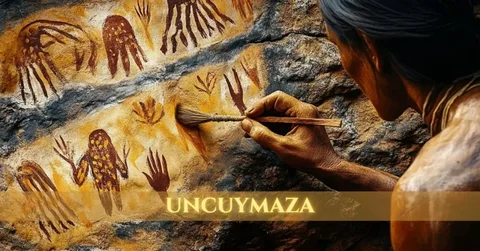
Forget the dictionary for a moment and stand behind a weaver instead. She is sitting on the ground in a courtyard in the high Andes, a woven strap around her waist, a half-finished cloth stretched tight between her body and a wooden post. Every few seconds she leans back, and the threads sing a little tighter. That scene, repeated in mountain villages for centuries, is the most honest way into uncuymaza.
A quick honest note before we go further. The word uncuymaza itself has no single settled definition, and you will find it explained in different ways in different places. In this article it is used the way most readers meet it: as a name for the Andean weaving tradition of Peru, Bolivia and Ecuador. The craft, unlike the label, is thoroughly real and still practised today. So this is a story about looms, dyes and hands, in that order.
A loom you wear: the backstrap loom
The traditional loom is called the awana in Quechua, and telar de cintura, the waist loom, in Spanish. Its genius is what it leaves out. There is no heavy wooden frame, no pedals and no machinery at all. One end of the warp, the set of lengthwise threads, is tied to a post, a tree or a stake in the ground. The other end is attached to a wide strap that passes around the weaver’s lower back. The weaver herself completes the machine.
Tension is everything in weaving, and here tension comes from the body. Lean back and the warp pulls tight, so the weft thread can be beaten firmly into place. Lean forward and the warp slackens, so the shed, the gap between raised and lowered threads, can be changed for the next row. A skilled weaver makes these movements hundreds of times an hour without thinking about them, the way you breathe. Visitors who try it are usually surprised by two things: how precise the cloth can be, and how much their back aches afterwards. It is physically demanding work, closer to rowing than to knitting.
The portability shaped a whole way of life. A backstrap loom rolls up into a bundle that can be carried to a field, a market or a neighbour’s courtyard, so weaving fitted around herding, farming and childcare. It needed no workshop, no imported parts and no fuel, only knowledge, patience and a strong back. Weaving on body-tensioned looms is among the oldest continuously practised crafts in the Americas, and in the high Andes it never fully stopped, even when factory cloth became cheap.
Fibre first, then grade
Everything begins with animals that can live where crops struggle. Alpacas give the fibre most people picture when they think of Andean cloth: soft, light, warm and slightly lustrous, in natural shades that run from white through fawn and brown to black. Llama fibre is coarser and tougher, better suited to pieces that will be sat on, dragged and loaded. Sheep arrived with the Spanish after European contact and their wool settled in as a practical middle option. Above them all sits vicuña, the wild relative whose fleece is so fine it was treasured in Inca times and remains protected and precious today.
What separated one finished cloth from another, though, was not only the animal. Andean cloth was graded, and the grades tell you who a piece was for. Chusi was the coarse, everyday grade, woven for hard use at home. Awaska was the standard household quality, the decent cloth of ordinary life. Qompi, sometimes spelled cumbi, stood at the top: the finest weaving, dense, smooth and richly patterned. Qompi was not sold in markets. It was produced by the aklla, specially chosen and trained women who wove for the Inca nobility and the priesthood, and finished pieces moved through the empire as diplomatic gifts, the kind of present one ruler sends another when the object itself has to carry respect.
| Fibre | Feel and strength | Typical use |
| Alpaca | Soft, warm, light, slight sheen | Garments, fine household cloth |
| Llama | Coarse, hard-wearing | Sacks, rugs, everyday heavy pieces |
| Sheep | Practical, widely available since European contact | General clothing and household cloth |
| Vicuña | Finest and rarest of the four | Treasured cloth for the highest ranks |
Hold those grades in mind when you shop today, because the same ladder still quietly operates. Two cloths can share a pattern and a village and be entirely different objects, one woven loosely in an afternoon, the other dense, even and slow-made. The grade, more than the motif, is where the value lives.
Colour that takes days, not minutes
Before a single thread reaches the loom, it has to be coloured, and in the traditional process colour is slow cooking. The reds that dominate Andean textiles come from cochineal, a tiny insect that lives on prickly pear cactus. Gathered, dried and ground, it produces deep reds, and with different preparations it can be pushed toward purple and wine shades. Blues come from indigo, yellows from q’olle flowers, and greens from leaves and mosses gathered in the hills. None of these colours simply soak in and stay. Dyestuffs need mordants, mineral helpers such as alum and iron salts, which bite the colour into the fibre so it survives sun and washing.
| Dye source | Colour it gives | What to know |
| Cochineal insect | Deep reds through to purples | Lives on prickly pear cactus; a little goes a long way |
| Indigo plant | Blues | Built up through repeated dipping |
| Q’olle flowers | Yellows | A highland flower gathered in season |
| Leaves and mosses | Greens | Local plants, so shades vary by valley |
A dye day can stretch into several days: fibre is washed, mordanted, dyed, rested, dyed again for depth, then dried in thin mountain air. This is also where natural colour shows its personality. One batch leans a shade deeper than the next, and a finished cloth may carry gentle tonal shifts across its bands. Machine-made copies, printed or dyed in one uniform pass, look flat by comparison. Once your eye learns to see that soft unevenness, you start reading it the way you would read brushstrokes on a painting, as evidence of a process rather than a flaw.
Patterns that speak without words
Andean weavers work in a visual shorthand that local eyes learn from childhood. Zigzag lines stand for the mountains that surround every village. Wavy lines are water, rivers and rain. Stepped motifs point to Pachamama, Mother Earth, and to the terraced fields cut into the slopes. These are not random prettiness. In communities where cloth carried identity for centuries, a pattern could say where a person came from and what the world around them looked like.
The best-known device is the chakana, the stepped Andean cross, which gathers a whole view of existence into one shape. Tradition describes three connected worlds: Hanan Pacha, the upper world of sky and sacred beings; Kay Pacha, this world, where people farm, weave and raise families; and Ukhu Pacha, the world below, tied to ancestors and the inner earth. A weaver who sets a chakana into a band is placing the wearer in the middle of that map, connected upward and downward at once. Readings vary from valley to valley, which is what you would expect from a language always spoken by hands rather than printed in manuals.
The manta: a cloth that carries a whole life
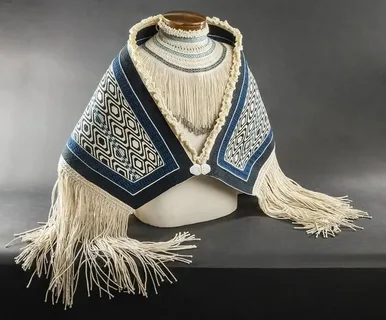
If qompi was the empire’s treasure, the manta is the people’s workhorse. A manta is a rectangular cloth, usually bold with bands of colour and rows of geometric motifs, and its job description never ends. Folded and tied, it carries produce from the field, firewood down a slope and goods to market. Spread differently, it becomes the sling in which a baby rides against a mother’s back, close, warm and able to watch the world while she works. The same cloth can be a blanket, a shawl or a ground sheet at a festival.
Because mantas were used daily rather than saved for ceremonies, they record ordinary life better than almost any other textile. Museums know this. Nineteenth-century mantas are held by the Metropolitan Museum of Art in New York and by Peru’s Museo Nacional de Antropología, Arqueología e Historia in Lima, where a carrying cloth is treated with the same respect as a ceremonial piece, because it preserves the patterns, dyes and handwork of women whose names were never written down. When you see a manta in a market today, slightly soft at the folds, that softness is not damage. It is the design working as intended.
Kept by women, with one famous exception
For most of Andean history, weaving was women’s work, and it was never a hobby. A girl learned at her mother’s or grandmother’s side, and her growing skill was read by the whole community as evidence of patience, discipline and readiness for adult life. The aklla, the trained weavers of qompi, were simply the highest formal expression of something every household valued. When cheap imported cloth flooded in during the twentieth century, it was women who decided, in village after village, that the old patterns were worth keeping alive anyway.
Then there is Taquile Island, sitting in Lake Titicaca, which politely breaks the rule. On Taquile, men are famous for knitting, producing the island’s fine knitted caps, while women weave on backstrap looms. Textile art there is so central to identity that UNESCO proclaimed it a Masterpiece of the Oral and Intangible Heritage of Humanity in 2005 and inscribed it on the Representative List in 2008. Taquile is a useful reminder not to flatten the Andes into one custom: the tradition is shared, but each community works out its own division of labour, motifs and pride.
The revival: cooperatives, associations and weaving towns
By the late twentieth century, many old styles had narrowed to a few elderly weavers, and younger people were leaving for the cities. The fightback came through organisation. In Peru, the Center for Traditional Textiles of Cusco was founded in 1996 to support Indigenous weavers across the Cusco region, recover fading techniques and sell members’ work on fairer terms. In Bolivia, ASUR built its name from the mid-1980s onwards by helping communities revive the Jalq’a and Tarabuco weaving styles, treating museum pieces as pattern libraries for living weavers. Beyond the Andes, the same cooperative idea travelled: Sna Jolobil, a Maya weavers’ cooperative in Chiapas, Mexico, dates to the 1970s, and Trama Textiles, a women’s weaving association in Guatemala, was founded in 1988.
| Place or organisation | Where | Known for |
| Center for Traditional Textiles of Cusco | Cusco region, Peru | Founded 1996; supports weavers in partner communities |
| ASUR | Chuquisaca, Bolivia | Revival of Jalq’a and Tarabuco styles since the mid-1980s |
| Sna Jolobil | Chiapas, Mexico | Maya weavers’ cooperative from the 1970s |
| Trama Textiles | Quetzaltenango, Guatemala | Women’s weaving association founded in 1988 |
| Chinchero, Pisac, Pitumarca | Cusco region, Peru | Weaving towns and demonstration centres |
| Puno markets | Lake Titicaca, Peru | Gateway to Taquile and its textile art |
The geography matters for travellers. Chinchero is famous for its women’s weaving associations and demonstrations, Pisac for its market, Pitumarca for deep textile knowledge away from the main tourist circuit, and Puno as the jumping-off point for Taquile. A demonstration at a cooperative, watching wool being washed, dyed with cochineal and woven, is the fastest education your eyes can get, and it usually changes what you are willing to pay afterwards.
Real cloth or a copy? A buyer’s short course
Markets across the Andes sell both treasures and imitations, sometimes on neighbouring stalls, so buy with your hands as much as your eyes. Start with the pattern: in a handwoven piece the motif is part of the cloth itself, visible on the reverse side, not printed on the surface. Feel the fibre: real alpaca has a soft, slightly warm handle, while synthetic blends often feel slick and cool. Look along a coloured band for those gentle tonal shifts that natural dyes leave behind. Then ask the simplest question of all: who made it, and where?
This is where cooperatives earn their place in the story. A cooperative-certified piece comes with a named community, and usually a named weaver, behind it, and the price reflects days of dyeing and weeks of weaving rather than a factory run. Mass-produced copies have their place as cheap souvenirs, as long as nobody pretends otherwise. The problem is only the middle ground, machine cloth sold at handmade prices with a romantic story attached. Buy the story you can verify: a weaver you watched, an association you visited, a label that names real people. The cloth will mean more on your wall, and the money will land in the right hands.
That, in the end, is what the modern interest in uncuymaza gets right, whatever the word’s tangled history. Behind every genuine piece sits the same triangle: a loom with no frame but a body, colour coaxed slowly out of insects and flowers, and hands that learned from hands before them.
Frequently Asked Questions

1. What is an awana?
Awana is the Quechua name for the traditional backstrap loom, called telar de cintura in Spanish. It has no fixed frame: one end of the warp is tied to a post or tree and the other to a strap around the weaver’s waist, and the weaver controls tension by leaning forward or back as she works.
2. What is the difference between chusi, awaska and qompi?
They are the three traditional grades of Andean cloth. Chusi is the coarse, everyday grade for hard household use. Awaska is standard household quality. Qompi is the finest grade, dense and richly patterned, historically woven for the Inca nobility and priesthood and given as diplomatic gifts.
3. Who were the aklla?
The aklla were specially chosen and trained women weavers of the Inca state. Their task was to produce qompi, the finest cloth, for the nobility, for priests and for gifts between rulers. They represent the highest formal level of a skill that ordinary women practised in every household.
4. Why does the colour vary slightly across a hand-dyed cloth?
Because natural dyeing happens in batches over several days. Cochineal, indigo, q’olle flowers and local leaves and mosses never produce exactly the same bath twice, and mordants such as alum and iron salts react a little differently each time. The gentle tonal shifts that result are a sign of hand dyeing, not a defect.
5. What is a manta used for?
A manta is a rectangular everyday carrying cloth with bold bands and geometric motifs. Tied one way it carries produce, firewood or market goods; tied another way it becomes a sling for carrying a baby on the back. It also serves as a blanket, shawl or ground cloth, which is why it is the most versatile textile in Andean daily life.
6. Why is Taquile Island different from other weaving communities?
On Taquile Island in Lake Titicaca the usual division of labour is rearranged: men are renowned for knitting the island’s fine caps, while women weave on backstrap looms. The island’s textile art was proclaimed a UNESCO Masterpiece in 2005 and inscribed on the Representative List of Intangible Cultural Heritage in 2008.
7. Which towns are best known for weaving around Cusco?
Chinchero is known for its women’s weaving associations and live demonstrations, Pisac for its large textile market, and Pitumarca for strong traditional knowledge away from the busiest tourist routes. Puno, on Lake Titicaca, is the gateway for visiting the weavers and knitters of Taquile Island.
8. What do weaving cooperatives actually do for weavers?
Cooperatives and associations such as the Center for Traditional Textiles of Cusco (founded 1996), ASUR in Bolivia, Sna Jolobil in Mexico and Trama Textiles in Guatemala (founded 1988) help recover fading patterns and techniques, organise training, and sell members’ work on fairer terms than individual weavers could usually negotiate alone.
9. How can I tell a handwoven piece from a mass-produced copy?
Check the reverse side: a genuine pattern is woven into the cloth and shows on both sides, while a copy is often printed or loosely machine-woven. Feel for the warm, soft handle of real animal fibre rather than a slick synthetic touch, look for gentle colour variation from natural dyes, and ask who made the piece and where. A cooperative label naming a community is a good sign.
10. How long does one fine piece of Andean cloth take to make?
Far longer than most buyers expect. Dyeing alone can take days, spinning is done by hand, and a dense, finely patterned cloth on a backstrap loom can take weeks of work, with the weaver leaning into the tension for hours each day. That time is the main reason genuine pieces cost what they do, and why very cheap “handmade” cloth deserves a second look.










Leave a Reply