

Type ponas robotas into a search box and you might expect a television page. That is still part of the story, but it is no longer the interesting part. In 2026 the polite Lithuanian way of saying Mr. Robot describes something happening on factory floors, in warehouses and on university campuses. Machines that walk on two legs, lift boxes with two hands and learn jobs that were designed for people are being reported at work in real buildings, not just on a stage under bright lights.
This article follows that newer meaning. It looks at the humanoid race as it stands in late 2026, separates what has been reported from what is only a target or a forecast, and asks a fair question along the way. If a robot can do a person’s shift, what happens to the person who used to do it?
A quick word on the name itself
In Lithuanian, ponas is a respectful word for Mr. or Sir, the kind of title you would use for a gentleman, and robotas simply means robot. Put together, ponas robotas is Mr. Robot, said politely. That politeness is worth keeping in mind. The new machines are not being sold as monsters or metal soldiers. They are being presented as helpers, colleagues almost, and the friendly name suits the sales pitch, even if the reality underneath is mostly business.
And yes, there was a television series
One short note, because many readers still arrive from there. Ponas Robotas is the Lithuanian title of Mr. Robot, the American thriller that ran from 2015 to 2019 and followed a troubled cybersecurity engineer drawn into hacking and protest against a powerful company. It was a clever, nervous show about screens and control, made before a robot could walk into a warehouse and start a shift. That is all this article needs from it. The robots below do not hack anything for television. They carry, stack, scan and repeat, and that ordinariness is exactly why they matter.
Why 2026 feels different from every robot year before it
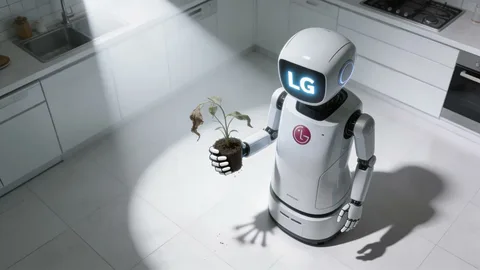
Robots are not new. Arms have welded car bodies for decades, usually behind fences, doing one movement millions of times. What changed is the shape and the brain. A humanoid is built for a human workplace, with stairs, doors, shelves and tools already sized for us, so it does not need the building rebuilt around it. At the same time, the language and vision models that made chatbots useful are being connected to cameras, hands and balance. The industry calls that physical AI, or embodied AI. In plain words, it is a chatbot given a body, and a body that can learn is a very different product from a machine that only repeats.
Sceptics have heard promises before, and some caution is healthy. A video of a robot folding a shirt in a laboratory is not proof it can work an eight-hour shift in a noisy warehouse. That is why the figures in this article are worded carefully. A deployment reported by a company is not the same as an independent audit, a target is not output, and a forecast is not a fact about the future. Read the labels and the story stays honest.
Tesla Optimus: the loudest name in the race
Tesla’s entry is Optimus, now in its Gen 3 form. As reported, the machine stands about 1.75 metres tall, weighs around 68 kilograms and can lift about 25 kilograms, numbers chosen to make it roughly person-sized for person-sized work. Reports put about 1,000 units at work inside Tesla’s Giga Texas plant by June 2026, doing internal jobs rather than being sold to outsiders. Tesla’s stated target was 5,000 units for internal use by the end of 2026, with external sales reported as planned from the first quarter of 2027.
Two details need flags, and honest coverage should not bury them. First, reports suggest Tesla may lease Optimus rather than sell it outright, which would keep the company in charge of servicing and software. Second, the much-shared figure of 20,000 units a week is a target said to be roughly a year away, not current output. A thousand robots in one factory is already notable. It does not need to be inflated into a production line that does not exist yet.
Figure AI and Digit: quieter, but already on shift
Figure AI takes a different route, putting its robots into other companies’ buildings. Its Figure 03, as reported, is about 1.7 metres tall, weighs 65 kilograms and carries a payload of around 22 kilograms. More than 200 units have been reported across BMW’s Spartanburg plant, Amazon fulfilment centres and construction sites. The company was valued at a reported 39 billion dollars in 2025, its Figure 04 design has been reported as frozen, and it has made a reported 3.5 billion dollar bet on computing power, because a learning robot is only as good as the training behind it.
Agility Robotics built Digit, a slimmer machine known for carrying tote boxes in warehouses. More than 500 units have been reported across Amazon fulfilment centres, and AGCO has been reported as deploying Digit at an agricultural-equipment factory in Kansas, a useful reminder that warehouses are not the only repetitive workplaces. In November 2026 Agility also became, as reported, the first United States-listed pure-play humanoid company, trading on Nasdaq under the ticker AGLT. Whether the share price behaves is a separate question. The listing itself shows investors now treat walking robots as a business, not a hobby.
Apollo, NEO and the rest of a crowded field

Apptronik’s Apollo is another person-sized design, reported at about 1.72 metres and 73 kilograms, with a payload near 25 kilograms. Instead of one giant launch, Apollo has been reported in pilot programmes with Mercedes-Benz, FedEx and Walmart. Pilots matter because they are where robots meet real floors, real staff and real shift patterns, and where plenty of promising machines have quietly failed before.
1X Technologies chose the factory itself as its headline. Its NEO factory in Hayward, California covers a reported 58,000 square feet and moved to full-scale production from 30 April 2026, as reported. Behind these names stand two more that no honest round-up can skip. Boston Dynamics brings decades of balance and movement research, while China’s Unitree brings speed and low prices. One supply-side count puts China’s share of humanoid output near 97 percent. Treat that as one count, not settled fact, because counting prototypes, shipments and working units gives very different answers. Even with that caution, the direction is clear. This is a global race now, not an American demonstration.
| Maker and model | Reported size | Reported payload | Where it has been reported at work |
| Tesla Optimus Gen 3 | 1.75 m, 68 kg | About 25 kg | About 1,000 units at Giga Texas, internal use |
| Figure AI Figure 03 | 1.7 m, 65 kg | About 22 kg | BMW Spartanburg, Amazon sites, construction |
| Agility Robotics Digit | Warehouse carrier | Tote carrying | 500+ units in Amazon fulfilment centres |
| Apptronik Apollo | 1.72 m, 73 kg | About 25 kg | Pilots with Mercedes-Benz, FedEx, Walmart |
The big technology layer underneath the bodies
A walking frame is useless without training, data and computing power, which is why the largest technology companies are moving in. Meta acquired Assured Robot Intelligence in May 2026, as reported, placing it inside its Superintelligence Labs work, and has been reported testing robots in data centres in Iowa and Ohio. Amazon, which already reports more than a million robots of all kinds across over 300 facilities, was reported to have invested 1.3 billion dollars in Neurala in January 2026 and a further 350 million dollars in Agility. Those are different kinds of robots and different kinds of investment, and they should not be blended into one headline number.
NVIDIA supplies much of the training ground. Its GR00T 2 models and Isaac Lab 3.0, launched at the CoRL conference in November 2026 as reported, are built to let robots practise in simulation before they touch anything real. That matters for safety and for cost. Crashing a virtual robot a million times is cheap. Crashing a real one once, near people, is not.
Then there is the forecast everyone quotes. Goldman Sachs, in its Global Physical AI report of August 2026, forecast roughly 6.5 million humanoids shipped by 2035, a market of about 138 billion dollars, with about 75,000 units in 2026 rising to 890,000 in 2030. Those numbers are a forecast, a reasoned guess from a bank, not a promise from the future. They are useful for showing how seriously investors take the field. They are useless as proof of what your local warehouse will look like in five years.
Forget humanoids for a moment: robots already run the errands
The humanoid race gets the cameras, but most working robots today do not look like people at all, and they are already ordinary. Shelves move themselves to pickers in fulfilment centres. Scanners roll along supermarket aisles looking for gaps and wrong prices. Small delivery bots from companies such as Starship and Kiwi cross campuses with food orders, stopping politely for pedestrians. In agriculture, machines guide, plant, sort and pack in places where seasonal labour has been hard to find for years. In healthcare, close to 16,700 medical robots were sold in 2024, per IFR reporting, helping with surgery, logistics and rehabilitation rather than replacing doctors.
| Sector | What robots mainly do there | Why employers want them |
| Warehouses and logistics | Move shelves, carry totes, sort parcels | Repetitive lifting, long shifts, peak-season pressure |
| Automotive lines | Welding, assembly support, parts handling | Precision, consistency, work beside existing lines |
| Agriculture | Planting, sorting, packing, equipment support | Seasonal labour shortages and seasonal deadlines |
| Healthcare | Surgical support, hospital logistics, rehabilitation | Accuracy and freeing staff time for patients |
| Retail | Shelf scanning and stock checks | Finding gaps and pricing errors across large stores |
| Campus and food delivery | Short trips with small orders | Cheap, frequent journeys that suit small vehicles |
Notice the pattern in that table. Robots spread first where the work is repetitive, physical and hard to staff, not where it is most creative. A warehouse tote does not need conversation. A shelf scanner does not need judgement about a frightened patient. That is why the humanoid question is sharper than the general robot question. A machine shaped like a person is aimed, eventually, at the jobs a person can simply be shown.
Jobs, safety and the argument nobody has won yet
It would be dishonest to write about ponas robotas in 2026 without the argument that follows it into every workplace. Supporters say robots will take the lifting, the night shifts and the tasks that injure backs and knees, in economies that cannot find enough workers anyway. Critics answer that a robot bought to help with a shortage can just as easily be used to cut a wage bill once it works, and that the savings rarely land in the pockets of the staff who remain. Both can be true in different buildings, which is why sweeping predictions help nobody.
Safety is the second argument, and it is practical rather than philosophical. A caged welding arm is predictable. A learning humanoid walking a shared floor is not, at least not yet, and standards, sensors and training have to prove themselves in pilots before scale is sensible. The third issue is quieter. A robot that watches, listens and learns in a workplace collects data about that workplace, including the people in it. Who owns that data, and who can replay it, deserves an answer before the robot arrives, not after.
What to watch, and what not to believe yet

Watch deliveries, not demonstrations. A robot that is still working at the same site six months later, doing an unglamorous job on an ordinary Tuesday, tells you more than any launch video. Watch whether external sales and leases actually begin, whether prices are ever published openly, and whether the forecast curve for 2030 survives contact with real factories. And keep the polite name in perspective. Ponas robotas sounds like a gentleman caller. The machines behind it are capital equipment, bought to move boxes cheaper and longer than people can. Some of them will genuinely make work safer and less grinding. Others will be expensive lessons. Telling those apart, site by site and figure by figure, is the real story of 2026, and it is only just getting started.
Frequently asked questions

What does ponas robotas mean in English?
It is Lithuanian for Mr. Robot. Ponas is a respectful word for Mr. or Sir, and robotas means robot, so the full phrase is a polite way of naming a robot as if it were a person.
How many Tesla Optimus robots are actually working?
Reports put about 1,000 Optimus units at work inside Tesla’s Giga Texas plant by June 2026, in internal roles. The 5,000 figure is a target for internal use by the end of 2026, and 20,000 a week is a longer-term target, not current output.
Can I buy a Tesla Optimus in 2026?
Not as an ordinary customer, based on the reports covered here. External sales were reported as planned from the first quarter of 2027, and reports suggest Tesla may lease the robot rather than sell it outright.
Where has Figure AI’s Figure 03 been reported working?
More than 200 Figure 03 units have been reported across BMW’s Spartanburg plant, Amazon fulfilment centres and construction sites. The reported figures are about 1.7 metres tall, 65 kilograms and a payload of around 22 kilograms.
What makes Agility Robotics’ Digit different?
Digit was built mainly to carry tote boxes in warehouses rather than to copy a full human worker. More than 500 units have been reported in Amazon fulfilment centres, AGCO has been reported deploying it in Kansas, and Agility listed on Nasdaq as AGLT in November 2026, as reported.
What is physical AI, in simple words?
Physical AI, also called embodied AI, means giving an AI system a body. Instead of only answering questions on a screen like a chatbot, the system uses cameras, movement and hands to see a real place and act in it.
Does China really make 97 percent of humanoid robots?
One supply-side count puts China’s share of humanoid output near 97 percent, but that should be treated as one count, not settled fact. Totals change a lot depending on whether prototypes, shipments or robots actually at work are being counted.
How big will the humanoid market become?
Goldman Sachs forecast, in August 2026, about 6.5 million humanoids shipped by 2035 and a market of roughly 138 billion dollars, with about 75,000 units in 2026 and 890,000 in 2030. That is a bank forecast, not a guarantee.
Are robots only a warehouse story?
No. Warehouses lead the headlines, but robots already work in car plants, agriculture, retail shelf scanning, campus food delivery and healthcare, where close to 16,700 medical robots were sold in 2024, per IFR reporting.
Will humanoid robots take people’s jobs?
Nobody honestly knows the full answer yet. Employers present them for repetitive, hard-to-staff and injury-prone work, while critics warn they can also be used to cut wage bills. The outcome will differ by workplace, which is why reported deployments matter more than predictions.








Leave a Reply